Business Storage Solutions: The Complete Guide for Small Business Owners

Smart Business Storage Solutions for Small Business Owners

Running a business means juggling a lot: inventory, equipment, documents, supplies, packaging materials, seasonal overflow, and a hundred little things that need a home. And for many business owners, the biggest challenge is… space.

Maybe your office is overflowing with last season’s products. Maybe your spare room is turning into a warehouse. Or maybe rising commercial rents are forcing you to rethink how and where you store the items that keep your business running.

That’s where business storage comes in.

In this complete guide, we’re walking you through everything business owners need to know, from the different options available to how much it costs and how it can help your business run more efficiently. Whether you’re a solo business owner or managing a growing team, this guide is your starting point for building a simpler, more organized, more scalable operation.

Let’s dive in!

What Is Business Storage?

Business storage is a secure, flexible, and cost-effective way to store items your company doesn’t need to keep on-site every day. Think of it as extra breathing room for your business, without the high cost of renting more office or commercial space.

The right storage solution supports how your business actually works. 

That means easy access when you need it, reliable security, predictable month-to-month pricing, and space for everything from tools and equipment to inventory, documents, and supplies.

As more businesses shift to hybrid work, downsize offices, and focus on staying agile, business storage has become a smart, practical solution. 

And the truth is, most businesses don’t need more office space. They just need a better place to store the things that keep them running.

What Types of Businesses Benefit From Business Storage?

Almost any small business can benefit from extra storage, but some rely on it more than others. If you fall into one of these categories, the right storage setup can make a noticeable difference in both your day-to-day workflow and your monthly overhead.

Service-Based Businesses

Contractors, plumbers, electricians, landscapers, cleaners, and other service pros often handle a lot of gear. Tools, spare materials, ladders, safety equipment, it all adds up. 

Keeping everything crammed into a garage or packed van can slow you down and wear out your equipment. Business storage gives you a safer, more organized solution that keeps everything in one place, so you can grab what you need and get to the job faster.

Product-Based Businesses (E-Commerce, Retail, Etsy Sellers)

Inventory is essential, but it can quickly take over your workspace. From stock and packaging materials to printing supplies and seasonal items, product-based businesses often outgrow their storage long before they outgrow their business. 

A reliable storage solution helps keep your inventory safe, organized, and ready to ship, no matter how busy your order volume gets.

Creative Professionals

Photographers, event planners, videographers, graphic designers, and stylists often have bulky items they don’t use every day: props, backdrops, lighting gear, signage, decor, and more. 

Storing these items off-site but within easy reach frees up space at home or in the studio and helps protect delicate (and often expensive) equipment.

Real Estate Agents & Property Managers

Real estate professionals deal with more “stuff” than most people expect. Yard signs, staging decor, tools, maintenance supplies, and boxes of paperwork can easily pile up. 

Storage keeps everything in one secure place instead of scattered across offices, cars, and spare rooms.

Food, Hospitality, & Event Businesses

While storage units aren’t suitable for perishable food, they’re incredibly useful for storing:

  • Seasonal outdoor furniture
  • Extra appliances
  • Decor
  • Event equipment
  • Non-perishable supplies

Restaurants, caterers, and event companies love storage to keep things clean and organized during slower months or seasonal shifts.

Nonprofits & Community Organizations

Nonprofits often operate with limited office space but still need room for donation items, signage, documents, event equipment, and supplies. A secure off-site storage solution provides breathing room and better organization.

Business Storage Units: What’s Available?

Not all storage options work the same way. The right choice depends on your business size, how often you need access, and what you’re storing.

Here’s a breakdown of the most common options and who they work best for:

Self-Storage Units

Self-storage units offer fixed sizes with flexible terms, making them a practical option for many small businesses.

What this looks like for a business:

  • Month-to-month rentals: No long-term commitments. Scale your space up or down as your needs change.
  • Multiple unit sizes: From small units for documents or supplies to larger units for inventory or furniture.
  • Convenient access: Many locations offer 24/7 access, drive-up units, gated entry, and secure locks.
  • Waterproof options: Ideal for items sensitive to heat, cold, or humidity.

Who this is best for:

  • Business with seasonal inventory or fluctuating stock levels; easy to scale space up or down as needed.
  • Small businesses or startups that don’t want to commit to long-term leases.
  • Companies looking for cost-effective alternatives to traditional warehouse space, especially when they need secure storage but not a full warehouse contract.
  • Businesses that need quick access to stored items, without the hassle of long travel, complicated leases, or large upfront commitments.

Warehouse Storage

Warehouse storage works well for high-volume businesses that need loading docks, forklifts, and large-scale inventory handling.

That said, warehouses are usually more expensive and often require long-term contracts, making them less practical for small or growing businesses.

Office Storage Rooms

Many small businesses try to store everything in-house until they realize that numbers don’t add up. Office space is expensive, and using it for boxes, inventory, or equipment isn’t the best use of premium square footage.

In most cases, moving excess items to storage is far more cost-effective than paying office rent for storage space.

Portable Storage Containers

Portable containers can be useful for construction sites or short-term events. However, they’re not ideal for long-term storage of sensitive items due to limited security and a lack of climate control.
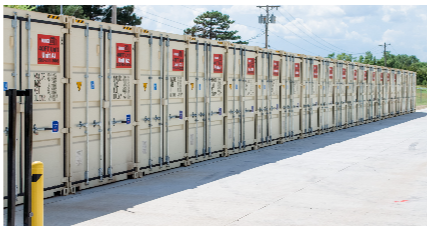
Shipping containers lined up for use.

What You Can (And Can’t) Store in Commercial Storage Solutions

Most business items are perfectly suitable for secure, off-site storage. But there are a few exceptions.

What you can store:

  • Inventory and stock
  • Tools and equipment
  • Office furniture
  • Marketing materials
  • Packaging supplies
  • Event equipment
  • Seasonal decor
  • Documents and archives
  • Appliances (non-perishables only)

What you can’t store:

  • Perishables or open food items
  • Hazardous or explosive items
  • Highly flammable items
  • Live plants or animals
  • Cash or extremely high-value valuables
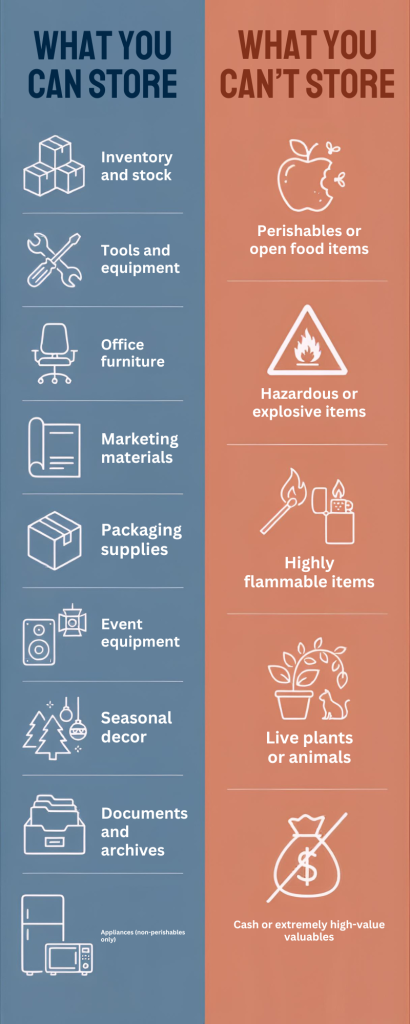
The general rule is: if it’s safe, non-perishable, and legal, it’s probably allowed.

How Much Does Business Storage Cost?

Your monthly storage costs depend on a few factors: how much space you need, what you’re storing, and the type of unit you choose. To give you an idea, here’s a rough breakdown of storage costs depending on the unit size:

  • Small units (5×10): $40 – $100

Perfect for documents, marketing materials, small supplies, or a few boxes of inventory.

  • Medium units (8×10 or 8×20): $60 – $250

Ideal for growing businesses with extra inventory, small furniture, or equipment.

  • Large units (8×40): $200 – $400

Great for high-volume inventory, large office furniture, or even vehicles.

These ranges give you a helpful starting point, but keep in mind that your actual cost can vary based on availability, unit features, and the length of your rental.

Choosing the Right Storage for Your Business

Choosing the right setup depends on how your business operates day to day. Here’s what to consider as you evaluate your options:

  1. Calculate Your Business Storage Needs

Start by taking stock of what you actually need to store:

  • How much inventory do you have today
  • How it fluctuates seasonally
  • Equipment and furniture dimensions
  • Packaging materials, supplies, and promotional items
  • How often do you need to access items

Getting a clear picture of your storage needs prevents overpaying for extra space or running out of room too soon.

  1. Choose the Right Type of Storage

Storage comes in different forms, each suited to different business needs. 

Self-storage units are flexible, secure, and cost-effective for most small to medium businesses. Warehouse-style storage works for high-volume operations, while portable containers are great for temporary projects. 

Think about how your business operates day-to-day and what will make access, loading, and unloading easiest.

Choose the Right Size

Choosing the right size ensures your items are organized, protected, and accessible without wasting money on unused space. Follow these steps:

  1. Assess Your Inventory: List everything you plan to store, including quantities and any items that require special care or climate-controlled storage.
  2. Measure Your Items: Know the dimensions of your largest items to visualize how much space you’ll need.
  3. Consider Your Storage Needs: Do you need climate control for sensitive items? Drive-up access for frequent loading?
  4. Match to a Unit Size: Use your assessment to select a storage unit size that fits your business. Here are some common options for business storage:

5’ x 5’ (25 sq ft): Great for small businesses needing to store paper documents, marketing materials, or a few boxes of supplies.

5’ x 10’ (50 sq ft): Ideal for storing excess inventory, small office furniture, or equipment for a growing business.

10’ x 10’ (100 sq ft): Perfect for medium-sized businesses with larger storage needs, such as bulk inventory, machinery, or multiple pieces of office furniture.

10’ x 20’ (200 sq ft) and up: Best for businesses with extensive inventory, large equipment, or even vehicles that need secure, accessible storage space.

Choosing the right size keeps costs down, avoids wasted space, and keeps your business flexible as storage needs change.

Check Security Measures

Keeping your business items safe is a top priority when choosing a storage solution. Look for facilities with secure access, like electronic gates and surveillance cameras, for added peace of mind. 

Convenient access hours let you get to your stored items whenever you need, while drive-up access makes loading and unloading supplies or equipment fast and hassle-free, helping your operations run smoothly.

How Business Storage Improves Efficiency and Profitability

Smart storage isn’t just about saving space; it’s about creating a more efficient, organized, and profitable business. 

When your storage system works with your operations (rather than against them), the impact is felt throughout your entire workflow.

  • More room in your workspace

Clutter makes it harder to focus, slows down daily tasks, and eats up valuable square footage. By moving non-essential or non-daily items off-site (such as excess inventory, equipment, or seasonal supplies), you free up space for the things that actually drive your business forward. 

A cleaner, more organized workspace helps teams work more comfortably, stay focused, and get more done in less time.

  • Lower operating costs

Office and commercial space is expensive when used to store boxes rather than to support customers or employees. 

Business storage provides a cost-effective alternative, allowing you to reduce the amount of office or warehouse space you need. This can lead to meaningful savings on rent, utilities, and overhead, without sacrificing access to your inventory or equipment.

  • Better organization and inventory control

Using dedicated storage helps you keep inventory, tools, and materials organized and protected. 

With a structured storage system in place, it’s easier to track what you have, avoid over-ordering, reduce damage or loss, and quickly retrieve what you need when you need it. For growing businesses, this level of organization can significantly improve day-to-day efficiency.

  • A more professional customer experience

When your workspace isn’t overcrowded with boxes or equipment, it shows. 

A clean, organized office or storefront feels more professional and welcoming to customers and clients. Faster order fulfillment, easier access to products, and a more polished environment all contribute to a better customer experience, one that builds trust and supports long-term growth.

  • Scalability for growing businesses

As your business grows, your storage needs will change. A flexible storage solution allows you to scale up during busy seasons or expansion phases, and scale back when things slow down, without major financial commitments. That flexibility helps protect cash flow while supporting long-term growth.

Why Choose MyStorageBox for Your Storage Needs

MyStorageBox makes business storage easy, flexible, and stress-free, exactly what small business owners need. 

  • Month-to-month rentals: Instead of complicated contracts or hidden fees, you get clear monthly pricing, no long-term commitment, and a setup that works around your schedule.
  • Fast check-in process: You can rent a storage unit online in minutes, manage payments digitally, and access your unit 24/7, whenever your business needs it. 
  • Drive-up access: Every unit comes with a drive-up access, so loading and unloading inventory, equipment, or supplies is quick and simple.
  • Safety comes first: MyStorageBox facilities feature gated access, perimeter fencing, and 24/7 video monitoring, so you can feel confident that your business items stay protected at all times. 
  • Free lock: A free lock is included, which means one less thing to worry about when getting started.

Whether you’re storing extra inventory, tools, furniture, or documents, MyStorageBox gives you a simple, affordable way to create more space and keep your business running smoothly.

Conclusion: Smarter Storage Helps Businesses Grow

Running a business is demanding enough, and storage shouldn’t be another problem to solve. The right storage solution can help you cut clutter, lower operating costs, and create a workspace that actually works for you.

By moving non-essential items off-site, businesses can free up valuable space, improve organization, and stay flexible as their needs change. Whether you’re storing inventory, equipment, documents, or seasonal items, smart storage allows you to focus on what really matters: serving customers and growing your business.

MyStorageBox makes business storage simple, flexible, and cost-effective, giving you the space to grow without unnecessary commitments or overhead. 

Ready to optimize your space and streamline your operations? Call us at (580) 300-3006!

Spring Storage Made Simple: Secure Self-Storage Units in Stillwater, OK

Your Guide to College and Residential Self-Storage in Stillwater, Oklahoma

Springtime is officially here in North-Central Oklahoma, and you know what that means:

  1. Thunderstorms
  2. College students are counting down the days until finals are over. 

Stillwater, Oklahoma, is home to Oklahoma State University, one of Oklahoma’s two largest state-sponsored universities. Every fall, the quiet, small city of about 48,000 swells with an influx of over 20,000 baby-faced coeds descending on OSU. While many students are from the local area and Oklahoma, OSU enrolls thousands of out-of-state and international students. 

For these students, storage units are a must. Let’s take a look at storage solutions in Stillwater, Oklahoma, and why My Storage Box is the perfect solution for college students and full-time residents alike. 

Finding the perfect storage unit in Stillwater, OK

Students move into Stillwater in the late summer and gear up for the better part of a year in school. Some of the more determined students will stay over the summer and take summer courses to get ahead.

But also, many students will end the year in May and head back home… wondering what to do with all the stuff they brought the year before and what they accumulated during the year. Moving it back home for summer break doesn’t make sense, especially if you’re an out-of-state student.

A self-storage unit in Stillwater is just the ticket. But how do you pick the right one? 

Most storage facilities use standard storage-unit buildings. You’ve seen them: row after row of corrugated steel doors. And there’s nothing wrong with these; they work well for plenty of people. But let’s be honest: Are they the most durable option out there? Probably not. 

MyStorageBox takes a completely different approach to storing your belongings in Stillwater: shipping containers. 

We start by using the best security access systems on the market, so you know that entry is secure. Then we bring in brand-new, unused 10’, 20’, and 40’ shipping containers. 

Why shipping containers? Keep reading. 

Beautiful Boomer Lake in Stillwater, Oklahoma

Non-Climate-Controlled Self-Storage for Your Belongings in Stillwater, Oklahoma

Sometimes you need climate-controlled storage for items sensitive to heat, humidity, or cold. But if you aren’t storing anything sensitive, a non-climate-controlled facility is a better option. 

And we believe that shipping containers make the best non-climate-controlled storage units for a few reasons:

  1. They are incredibly strong. Shipping containers are built to go across the ocean, then get stuff on a semi-trailer or a train and move across the country. Not for the faint of heart. 
  2. Shipping containers are made to be waterproof, as a necessity for their job. 
  3. Shipping containers have two large swing-open doors that facilitate quick loading and unloading and make it easy to move items in and out. 
  4. They are tough as nails and very secure. 
Shipping containers lined up for use.

Why Residents of Stillwater Need Self-Storage

College students are among the primary drivers of commerce in Stillwater; when classes are in session, the city swells by about one-third. However, most college dorm rooms or rentals are short on space. A self-storage unit is the perfect way to maintain access to any items you want to keep close but don’t have room for in your immediate living space. 

Our shipping containers are large. A 20’ shipping container storage unit has approximately 160 square feet of storage, and a 40’ shipping container doubles that!

This is a lot of space for anyone who wants to store just about anything. Spare beds? You got it. Dressers? No problem. Tub after tub of household goods? Too easy. 

Of course, we don’t want you to think that we are limiting our services to college students; far from it. Self-storage offers an affordable way to keep all kinds of stuff when you don’t quite have enough room at home. Some of the most popular items are:

  • Off-season items (clothing, sleds, etc). 
  • Sports equipment
  • Heirloom and antique furniture
  • Tools. Our storage units are a great, super-secure way to store your job site equipment. With 24/7 access, you can swing by anytime before or after your workday and grab or drop off whatever you need. 

Self-Storage For College Students

Back to the college scene, self-storage is one of the best services around for students. After a few years, most people tend to start accumulating household goods, furniture, and all kinds of other stuff. Then, suddenly, time’s up when you hit the end of that fourth year. Unless you find work in the area, you have to start looking for work that could take you just about anywhere. In the meantime, dorm life is over, and your lease may be up. 

MyStorageBox’s storage solutions take the worry about what to do with your household goods. They are here safe and sound while you go on your job hunt, and when you figure out where you’re landing, you can just pull up a moving truck, load up, and head out to your next adventure! The massive 7’8″ x 7’5″ door opening makes loading and unloading a breeze.  

And we know what kind of hours college students and recent college grads keep; we were in those shoes once upon a time! Don’t worry; your household goods are in good hands behind our security fence and secure entry. 

Do I need a climate-controlled storage unit in Stillwater, OK?

Oklahoma is a land of extremes. Our summers are HOT, the winters can be icy and bitter, and our springtime weather is notoriously volatile. There are circumstances in which a climate-controlled self-storage unit is a better option, particularly if you have items that are sensitive to heat, humidity, or prolonged cold exposure. 

That said, no other storage option withstands the elements better than shipping containers. These units are made to travel across the ocean on rough seas, through storms, and whatever else the ocean has to throw at them. Once they are offloaded, they also travel through the worst weather and across the roughest terrain by train and in tractor-trailers. 

Whatever weather they see while sitting in our lots is nothing compared to what they would endure in their intended role. 

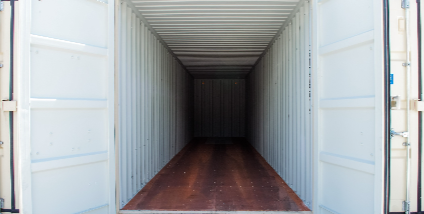
Interior of a shipping container.

Parting Thoughts

Northern Oklahoma is beautiful with huge lakes, green grass, and lots of sunshine. If you are making Stillwater your home, whether for just a few years while you earn a degree or you’re moving here, MyStorageBox is the best place to store your belongings before, during, or after the move. 

We offer a unique storage solution using the most durable storage solution around, offering storage unit options in three sizes:

  1. 8×10, which offers approximately 80 square feet of storage. 
  2. 8×20, for around 160 square feet of storage
  3. 8×40, providing about 320 square feet of storage. 

Whatever you need to store, we have a solution for you, and you can rest assured that it will withstand just about anything Oklahoma has to offer. 

Best Packing Tape For the Big Move

The Ultimate Guide to the Best Packing Tape for Every Need

When you’re boxing up your belongings, whether you’re moving to a new home, or organizing your storage unit, it’s easy to overlook one of the most important supplies: packing tape.

Sure, it’s not as exciting as picking out new labels or color-coding your boxes. But when your tape fails and a box bursts open mid-move, you’ll wish you had chosen more carefully.

So, what’s the best packing tape to get the job done right? Let’s break it down.

Why Packing Tape Quality Matters

It’s tempting to grab the cheapest tape you can find, but not all packing tape is the same. Low-quality tape can peel off easily, split when you try to apply it, or lose its stickiness when exposed to heat, cold, or humidity.

If you’re planning to store items long-term or ship boxes across the country, you’ll want a reliable tape that holds up under pressure. Literally. Plus, different tasks require different tape features. So, before you make a decision, you’ll also want to consider what your tape will need to handle. More on that in the next section!

Shipping vs Packing Tape Differences

Although packing and shipping tapes often look alike, they serve very different purposes. Here’s what you should know:

FeatureShipping TapePacking (Storage) Tape
ThicknessThinnerThicker
Adhesive TypeHot melt adhesiveAcrylic adhesive
Ideal UseMailing lightweight boxesLong-term storage and moving
Durability1-2 yearsUp to 10 years, even in fluctuating conditions

Shipping tape is ideal for mailing a small parcel, but it’s not built to hold up in the back of a moving truck or in a humid storage unit. For moving or storage, you want packing tape (also called storage tape), which holds up under pressure.

What to Look for in a Packing Tape

Let’s be real. Tape isn’t the most exciting part of moving or packing, But when it fails, you’ll wish you’d picked a better one. Whether you’re packing something fragile for storage or moving across the country, the right tape makes everything easier and less frustrating. Here are some features to consider when choosing a packing tape:

Strength and Strong Adhesion

You want tape that sticks—and stays stuck. Go for options labeled heavy duty or industrial strength labels, especially for full and heavy boxes. Tapes made from hot melt adhesive tend to hold better than basic acrylic alternatives, especially over time.

Also worth checking: tensile strength. That’s how much weight the tape can handle before snapping. If you’re packing books, kitchenware, or just cramming too much into one box (we’ve all been there), this matters.

Durability Over Time

Quality tape should be tough enough to handle the conditions of both moving and long-term storage. So, look for tape that’s:

  • Tear resistant: Holds up through dragging, stacking, and shuffling, which is essential for heavy boxes or rough handling;
  • Temperature resistance: Won’t peel off in the heat or freeze in the cold;
  • Moisture resistance: Great if you’re storing things in damp areas or moving during rainy weather.

Material, Thickness, and Size

Packing tape comes in various materials and thicknesses, usually from 1.9 to 3.1 mils. Thicker tapes are for the toughest jobs. If you’re dealing with heavier stuff or long-term storage, thicker tape is worth it. For lighter jobs, a thinner tape does the trick.

Make sure the tape roll is wide enough. 1.88 inches is standard for most boxes. And consider how much tape you’ll need. Longer rolls are more economical and reduce the need for frequent replacements.

Ease of Use

A good rolling tape shouldn’t fight back. The best packing tapes unroll smoothly, work with handheld dispensers, and resist splitting or sticking to themselves.

To make packing quicker and less frustrating:

  • Choose a tape that unrolls evenly and fits a standard tape dispenser or gun.
  • Avoid overly thin tapes; they’re more likely to tear or fold.
  • Keep an extra roll and dispenser on hand to avoid delays when packing with someone else.

Other Types of Tapes (And When to Use Them)

Not all tape is created equal. When it comes to packing and moving, the type of tape you choose can make a big difference in how secure and durable your boxes are. Here’s a quick guide to different kinds of tapes and when you should use them.

Heavy-Duty Packing Tape

Heavy-duty packing tape is designed for tough jobs. It’s made with strong adhesive and typically features an acrylic formula that withstands temperature fluctuations and stress during transit and storage. This type of tape is ideal for sealing boxes that will be moved long distances or stored for an extended period. 

  • Best for: Long-term storage, extreme temperatures, heavy boxes

Filament Strapping Tape

Filament strapping tape is reinforced with fiberglass strands that provide extra strength, making it perfect for boxes that will be exposed to rough handling, extreme conditions, or a lot of movement. This tape is often used for sealing large or heavy boxes, as it can withstand a lot of weight and tension.

  • Best for: Heavy-duty boxes, rough handling during transport, items exposed to heat or cold

Gummed Paper Tape

Unlike standard adhesive tapes, gummed paper tape requires water to activate its adhesive, creating a very strong, permanent bond. It’s ideal for long-term storage, especially for boxes that will be exposed to extreme climates. The downside is that you need to wet the tape before use, which can be cumbersome. 

  • Best for: Heavy-duty storage, extreme temperatures, secure packaging that can’t be easily removed

Labeled Tape (SmartMove, U-Haul EZ Read)

Labeled tape like SmartMove or U-Haul EZ Read, features printed room labels (e.g., “Kitchen,” “Bedroom”) directly on the tape itself. This type of tape lets you seal and label your boxes in one go, helping you stay organized throughout the moving process. It’s a time-saver when you need to quickly identify where each box should go. 

  • Best for: Labeling boxes for easy identification, moving with a large number of boxes, quick organization

Tapes to Avoid When Moving

While some tapes may seem like convenient options, they’re not ideal for packing and moving. For example:

  • Duct tape: While extremely versatile, duct tape doesn’t stick well to cardboard, leaves behind sticky residue, and weakens in extreme temperatures;
  • Brown paper tape: Not strong enough to handle the demands of moving, tears easily, and is not waterproof;
  • Masking tape: Weak adhesive and won’t hold up to movement or long-term storage;
  • Craft/Washi Tape: Decorative and not functional for packing;
  • Gaffer Tape: Expensive, not made for packing and moving boxes.

Final Thoughts

Investing in the best packing tape may not seem like a big deal… until you’re halfway through moving or storing and your boxes start falling apart. Choosing the right tape will help ensure your belongings stay safe, your boxes stay sealed, and your stress stays low. 

Don’t let little things like flimsy tape ruin your big move or storage project. For added peace of mind, check out My Storage Box for reliable storage solutions that keep your items secure long after the move is over. With the right tape and a little planning, you can make your next move a lot easier and less stressful! 

How to Use Self-Storage for Staging Your Home to Sell Effectively

Use Self-Storage to Help StageYour Home!

You’d be surprised at how much of a difference first impressions make when selling a home! One of the best ways to create that “love-at-first-sight” moment for potential buyers is through home staging. 

Home staging is about making the space feel desirable so that buyers can easily imagine themselves living there. And a key tool in this process is using a self-storage unit.

Self-storage allows you to clean out clutter, store personal items, and remove excess furniture, all of which allow the space to shine and make it easier for buyers to fall in love with the property.

If you’re in the process of selling your home and you want to increase your chances of a quick sale, you’re already on the right track by reading this article. 

We’re here to help you understand home staging better and how you use self-storage to do it right. Let’s dive in.

Why Home Staging Matters

Home staging is the process of preparing a property to appeal to the widest possible pool of buyers. It involves redecorating, rearranging furniture, deep cleaning, and sometimes even decluttering. 

The goal is to make your home as appealing as possible to potential buyers, so they can immediately see themselves living there.

Now, we’re sure your home is already beautiful as is. But here’s the thing: home staging is not about what you like. Your home is YOUR home, but when it’s on the market, it needs to feel like a place anyone could picture themselves calling home.

They need to be able to imagine their life unfolding within those walls. That means your personal touches, while meaningful to you, might not have the universal appeal that helps others connect with the space.

The reality is that buyers are more likely to fall in love with a property that feels spacious, light-filled, and well-maintained. Yes, that means no clutter and no things lying around the living room…

And let’s not forget; in a competitive market, staging can be the best way to get top dollar for your home.

How Self Storage Helps With Home Staging

Self-storage is a powerful tool for setting yourself up for success with home staging. It’s a small investment that can yield big results when it comes to impressing potential homebuyers and securing a great offer. Here’s how it can make a difference:

  • Declutter Without Stress: Clear out unnecessary items without the hassle of finding space at home, creating a calm and inviting atmosphere for buyers;
  • Store Personal Items for a Neutral Look: Remove personal mementos to create a neutral environment where buyers can envision themselves living;
  • Make Rooms Look Bigger: Open up cramped spaces by temporarily removing bulky furniture or items, making it feel spacious and functional;
  • Organize and Streamline Storage Areas: Tidy up closets, basements, and garages to show how much your house offers in terms of ample storage space;
  • Keep Your Home Show Ready: Stay prepared for showings at a moment’s notice by using self-storage to quickly stash away anything that’s out of place.

Ultimately, a storage unit lets you focus on the important task of staging and selling your home without worrying about where to store your belongings or if they’re safe.

Key Steps for Using Self Storage for Staging

To make the most out of self-storage and ensure your home staging is as effective as possible, follow these key steps:

Plan Ahead and Assess What Needs to Go

First, take a good look around your home and decide what can stay and what should be removed. Keep your goal in mind: creating a clean universally beautiful space. This means putting away your collection of family photos, that quirky painting you found on your vacation, bold decor choices, or anything that makes the place feel cluttered or overly personalized.

Make a list of everything that should be stored away and that can go into a storage unit. When placing them, think strategically. Organize them in a way that makes it easy to retrieve anything you might need later. Use sturdy boxes, label everything clearly, and store frequently accessed items near the front. If you’re storing furniture, consider using protective covers to prevent dust or scratches. Stack heavier items on the bottom and lighter ones on top to avoid damage.

Then, you can proceed to the next step of staging your home so that you can sell it for top dollar.

Prepare Your Home for Staging

Before you start staging, your house needs to be spotless. This step involves a deep clean (yes, those neglected corners, too), any minor repair you’ve been putting off, and of course, decluttering. 

Make necessary minor repairs such as fixing leaky faucets, touching up paint, and replacing outdated light fixtures. Declutter and depersonalize every room as much as you can to create a neutral but welcoming space.

If the process feels overwhelming, consider hiring a professional home stager for expert guidance. Do your best, and you’ll reap the benefits later when you have a quick and profitable sale on your house.

Stage With Purpose

Now comes the fun part—time to make your home shine and create that all-important “wow” factor! Staging with purpose means transforming each space to highlight its best features while making buyers feel at home the moment they step inside.

Since the goal is to help potential homebuyers envision themselves living there, focus on creating a warm, inviting atmosphere, especially in key areas like the living room and kitchen. These are the heart and soul of the home, where people gather, so you want to make them look functional but also stylish and spacious.

When it comes to the bedrooms, think warm and cozy. The right lighting, soft bedding, and a neutral color palette, can make the room look ideal for a restful night’s sleep. 

Additionally, consider staging the outdoor spaces, such as the patio or backyard, to make the home feel even more inviting.

Stage Your Home for Listing Photos

Your listing photos are the very first impression buyers will have of your home, so make them count. Aim for high-quality, well-lit photos. Capture your home from the right angles to highlight its space and features. And don’t hesitate to ask your realtors for assistance with real estate staging if needed. Sometimes professional stagers can help bring your vision to life and ensure your home looks its absolute best.

Before taking photos, make sure the home is clean and clutter-free. Even the most beautifully staged home can lose its appeal if there’s a visible mess all around. 

Use your self-storage unit to tuck away anything that doesn’t contribute to the overall aesthetics. Keep only the essentials in place to create a clean, open, and inviting space.

Avoid Common Mistakes in Home Staging

Home staging is simple but still some mistakes can happen when you’re doing it for the first time. To keep things running smoothly, be mindful of these common staging mistakes:

  • Less is more when it comes to decor. Over-accessorizing can make a space feel cramped and distracting;
  • Bright, bold colors might seem fun but they can be off-putting to some buyers. Stick to neutral colors that let the space speak for itself;
  • And please, keep the house clean and clutter-free before showings. Nothing says “this place is loved” like a well-maintained space;
  • Pro tip: Avoid using self-storage to store items that are essential to the staging process such as furniture that defines a room’s function, tasteful decor that enhances the space, or anything that makes the house feel warm.

Choose the Right Self Storage

Alright, we’ve reached the final step: choosing the right storage unit. It’s time to take that inventory list you’ve carefully made and find a place that works for both your stuff and your budget. 

You want a unit that fits everything comfortably, without being cramped or unnecessarily spacious. So, pick a unit size that makes sense for your needs. Too small, and you’ll run out of space. Too big, and you’ll pay extra money for space you don’t need. If you’re storing anything valuable, go for waterproof facilities to keep them safe. Remember that security is vital, so look for facilities with 24/7 surveillance and gated access.

To make things easier for yourself, choose a facility in a convenient location that’s close to your home. This will make dropping things off and picking up much simpler.

And when it comes to access, make sure it’s a facility where getting to your unit is hassle-free. No one wants to deal with parking and lugging things all over the place, right?

Ready to Rent a Storage Unit?

Now that you know how essential self-storage can be for home staging, it’s time to make it happen. It’s all about working with what you have in your house to present it in the best possible light. By thoughtfully arranging furniture, decluttering, and using self-storage to remove distraction, you’ll create a space that feels bigger, brighter, and more inviting.

Shipping containers lined up for use.

If you’re on the hunt for self-storage units in Ponca City, OK, My Storage Box is here to make life easier for you.

We offer affordable, secure, and easily accessible storage units to help you achieve the perfect staging setup. Our facility is fully fenced, gated, and features keypad access, so you can come and go with peace of mind, knowing your belongings are safe.

Have questions or ready to get started? We’re available 24/7, every day of the week. Reach out anytime, and we’d be happy to help you find the perfect storage solution!

2025 Moving Trends: Where’s Hot in the Midwest for New Residents

Midwest Migration 2025: Affordable Hotspots for Your Next Big Move

As the economy evolves and personal priorities shift, so do the places Americans choose to call home. Across the country, we’re seeing new patterns take shape, and one region is clearly standing out:

The Midwest.

This region is experiencing a major moment right now. Affordable housing, a thriving job market, and a lower overall cost of living are drawing new residents from every corner of the country. 

As prices soar in coastal cities, more people are looking inward and discovering that the Midwest offers more than just open skies and friendly neighbors (though it has plenty of those, too).

If you’re planning a move in 2025, understanding the latest moving trends and the most in-demand locations can help you make a smarter, low-stress transition.

Top Midwest States for New Residents

If you’re looking for a place that balances opportunity with affordability, the Midwest has some serious contenders. 

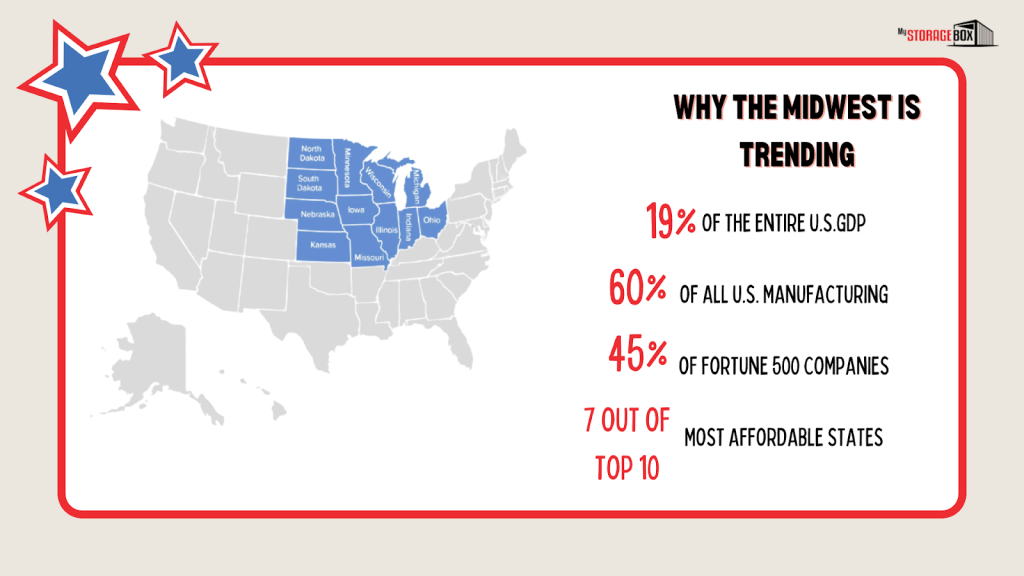
In 2025, Minnesota, Wisconsin, Michigan, Indiana, Ohio, and Nebraska stand out for their strong job market, a lower cost of living, and housing affordability, often well below the national average.

Over the past few years, the Midwest has consistently gained attention as more people seek alternatives to high-cost coastal areas. According to the latest US News & World Report rankings, Nebraska, Minnesota, and Iowa are among the top-performing Midwest states in overall quality of life, infrastructure, and fiscal stability. 

Indiana, Ohio, Michigan, Nebraska, Kansas, and Missouri also made the top list for affordability, making the Midwest a compelling destination for individuals and families seeking a fresh start without the financial strain that comes with living in areas above the national average.

Popular Cities in the Midwest

Affectionately known as “America’s Heartland,” The Midwest offers a diverse mix of vibrant cities, charming suburbs, and up-and-coming small towns, all with a uniquely welcoming vibe. Whether it’s water sports on the Great Lakes or a stroll down the architecturally rich streets of Chicago, there’s something for everyone in this region.

According to Livability, top Midwest cities to call home are Carmel and Fishers, Indiana, Naperville in Illinois, Overland Park in Kansas, Troy in Michigan, and O’Fallon in Missouri. These communities stand out for their safety, quality schools, strong local economies, and family-friendly amenities.

Looking ahead in 2025, metro hubs like Columbus, Ohio, Indianapolis, Indiana, and Detroit, Michigan, are among the most popular relocation destinations. These cities offer a wide range of opportunities in industries like tech, healthcare, and education, alongside affordable housing, walkable neighborhoods, and plenty of outdoor recreation. 

Columbus, in particular, continues to attract young professionals with its energetic downtown, diverse food scene, and budget-friendly lifestyle. 

Interestingly, even smaller cities are drawing new attention. 

As USA Today reports, younger buyers, including Millennials entering the housing market, are increasingly settling down in places like Athens, Ohio; Aberdeen, South Dakota; and Williston, North Dakota. It’s clear that small-town America is in the midst of a big shift, and the Midwest is leading the way.

Why The Midwest is Trending in 2025

If you’re feeling the pressure of high costs, it’s worth asking: Where can I actually build a life that doesn’t feel like a constant hustle? That’s where the Midwest comes in for a lot of folks in the country. 

People are recognizing the value of settling down in a place where you can breathe a little easier, financially, emotionally, and physically.

Source: The Hustle, Business Insider

Peace of mind is priceless, and the Midwest is delivering. If you’re curious about the key reasons why the Midwest is having a moment in 2025, we’re here to break it down for you.

Affordable Housing in the Midwest

If there’s one thing that draws people to the Midwest in droves, it’s the affordability. Compared to places like New York or California, housing prices here are refreshingly down-to-earth. Whether you’re dreaming of a starter home in Ohio or an apartment near downtown Detroit, the Midwest offers a wide range of options that don’t wipe out your savings.

States like Michigan and West Virginia are regularly ranked among the most affordable places to live, and you can still find neighborhoods where owning a home is within reach. In Indiana and Ohio, it’s possible to rent or buy without sacrificing safety, good schools, or local charm.

People are Genuinely Nice

There’s a reason why the Midwest is often called “America’s Heartland,” and it’s not just about geography. It’s the people. 

Midwesterners have a well-earned reputation for being warm, welcoming, and downright friendly. 

According to a 2013 study from the University of Cambridge that analyzed the personality traits of over 1.5 million Americans, those living in the Midwest scored “moderately high in extraversion, agreeableness, and conscientiousness,” traits that make for genuinely pleasant neighbors and communities.

It’s not unusual to be greeted with a smile and a wave from complete strangers in this region. That kind of everyday kindness can go a long way in making a new city feel like home.

Emerging Trends in the Midwest

One of the most noticeable shifts happening in 2025 is the rise of mid-sized cities and smaller towns. Why? Because people are craving a slower pace without giving up modern conveniences. Cities like Fort Wayne, IN, or Duluth, MN, are stepping into the spotlight, offering affordable living, growing job markets, and vibrant communities. 

Remote work is another game-changer. With the ability to work from anywhere, many Americans are leaving high-rent major cities behind in favor of the Midwest’s open spaces and lower costs.

Even cities like Tulsa, OK, technically southern but often grouped with the Midwest lifestyle, are rolling out the welcome mat for remote workers with relocation incentives, art scenes, and a strong sense of community.

Entertainment Scene in the Midwest

There’s a common misconception that the Midwest is just cornfields and diners, but that’s far from the truth nowadays. Sure, the region is known for its agricultural landscape and has a strong diner culture, but right now, its cultural landscape is booming.

From indie movie festivals in Ohio to art walks in Milwaukee, there’s no shortage of ways to stay entertained. In Chicago, you’ve got world-famous architecture, comedy clubs, and the Art Institute of Chicago. Over in Detroit, the creative energy is infectious, with mural-covered buildings, live music venues, and the Detroit Institute of Arts drawing locals and visitors alike. 

Outdoor activities lovers will also find their haven here in the Midwest, with thousands of miles of trails, rivers, lakes, and seasonal activities like snowshoeing or paddleboarding.

Cost of Living in the Midwest

Life in the Midwest doesn’t just cost less. It gives you more. More space, more time, more savings. 

Budget-friendly states like Ohio and Indiana consistently rank among the most affordable places to live in the country. Lower taxes, utility costs, and groceries help families and individuals alike get more bang for their buck.

For anyone trying to build their future or simply find financial breathing room, the Midwest is a smart move. You can live comfortably, save money, and still enjoy great restaurants, entertainment, and schools. 

Who is Moving to the Midwest?

The Midwest is attracting all kinds of new residents:

  • Young professionals looking for employment opportunities without the chaos of bigger cities
  • Families in search of safe neighborhoods and excellent schools 
  • Remote workers are eager for more space and a lower cost of living
  • Retirees are ready to enjoy their golden years without draining their savings

This mix of newcomers brings fresh ideas and energy to Midwest communities, helping revitalize downtowns, support local businesses, and create new cultural hubs. Diversity is growing, too, making the region even more welcoming for people of all backgrounds.

The Midwest is not just trending right now, it’s transforming. And it’s making a pretty compelling case for why it should be your next home.  

Tips For a Smooth Move in 2025

Let’s be real: relocating is stressful. And the best thing you can do for yourself? Don’t fight it. Accepting that some chaos is part of the deal can actually make the whole process feel more manageable. Seriously. But that doesn’t mean you’re stuck doing it all alone. 

There are plenty of ways to make your move smoother, smarter, and way less headache-inducing. Here are a few tips to help you stay one step ahead:

  • Start Early: Secure housing, job opportunities, and hiring movers at least 2-3 months in advance;
  • Visit Ahead: If possible, visit your future city to explore neighborhoods, schools, and lifestyle options.
  • Plan Ahead Your Budget: Moving costs can add up quickly, so factor in everything, from moving truck rentals to security deposits, well ahead of time.
  • Declutter: Don’t bring everything, especially not unnecessary clutter. Donate or sell items you no longer need;
  • Use Storage Wisely: If there’s a gap between move-out and move-in dates, or you need time to get settled, temporary storage can be a lifesaver.

Move Smarter With My Storage Box 

With its unique mix of affordability, opportunity, and culture, the Midwest is not just a flyover country anymore. Whether you’re drawn by job prospects, lower living costs, or a better quality of life, this region continues to prove itself as a smart, rewarding place to call home.

If you’re planning a move in 2025, make it easier with My Storage Box. We’re here to help you move smarter, stress less, and start fresh.

We understand that moving is not just about getting from point A to B. It’s about transitions, timing, and flexibility. That’s why we offer convenient, affordable, and secure storage solutions to keep your belongings safe during your relocation. 

Let us help make your transition as smooth and stress-free as possible. For any questions, call us for more details at (580) 300-3006!