Top Padlocks for Self Storage Units in 2026

Don’t Get Broken Into: Choosing the Right Storage Unit Lock in 2026

2025 has come and gone, and we are now closing in on the second quarter of 2026. With the end of another school year in sight, people are already thinking about moving or are looking for a place to put their seasonal and off-season items because they overbought. A self-storage unit is a great place to put your overflow, or to store things while your house is staged. But you want to know that it is secure.

The final step in securing your personal belongings in a self-storage unit is choosing the right lock. Our shipping containers are made to use standard padlocks and disc locks, so we’re going to talk about the best padlocks for self-storage for 2026 (and beyond). 

Best Locks for Storage Units

Alright, so what exactly makes the best lock for a storage unit? Well, there are a few things we are looking at to reach this conclusion. 

First, how is it selling? We aren’t looking for any fly-by-night, cheap knock-offs here; we want the locks that keep crooks out.

How are the ratings? No mixed reviews here. We only want to know the ones that consistently lead the charge, so to speak. 

And finally, what do they bring to the table that makes them unique or useful, rather than gimmicky or cheap? It has to be value-added with minimal downside. 

Desired Tools 4-Digit Combination Lock

Alright, so this first lock is an Amazon special, but let’s look beyond that for a minute. This lock has almost 15k reviews with 4.5 stars on Amazon. For a price point below $10, it’s definitely worth a try. 

A hardened steel shackle will dissuade all but the most determined crook. Note: Let’s be real for a second. A basic Harbor Freight or Amazon 4 ½” angle grinder with metal cutting wheels defeats every single padlock with no exceptions. They are just loud and throw sparks everywhere, which is why criminals tend not to use them. We are looking at locks that resist cutting from common bolt cutters and other hand tools, and this local uses a hardened steel shackle with a zinc alloy body, making it a fine choice for indoor and outdoor applications. 

We like the simple combination mechanism here because the key is always with you as long as you remember it. Also, the fourth number in the combination adds ten times as many combinations as a standard three-digit combination lock (ten thousand compared to one thousand). If you have a hard time keeping track of all your different keys, this is a great place to start. Check it out here.

Master Lock No. 930DLHPF Heavy-Duty Padlock

Master Lock is probably the best-known padlock manufacturer in America and basically runs the tables on fine locks. With a history as storied and well-established as Master Lock, it is no wonder at all that they are on our list more than once. 

The 930DLHPF is a fairly standard padlock available with either a 2” or a 2 ½” shackle, depending on your needs (i.e., chain size and thickness).

Features

  • 2” shackle clearance
  • 2 ½” wide solid steel body to prevent breakage and destruction.
  • Hardened boron alloy shackle to resist cuts 
  • Dual ball bearing locking mechanism to protect from prying and hammering. 
  • 5-pin cylinder for pick resistance.
  • A removable cylinder so you can rekey your own lock. 

This lock model has been around for a long time and has a proven track record of excellence. 

ABUS Diskus 20/70 Stainless Steel Padlock

Alright, let’s deviate from the traditional padlock design and take a look at a disc lock, the ABUS Diskus 20/70 stainless steel disc padlock. 

The ABUS Diskus 20/70 is made to afford a high level of security for its users. It offers 360 degrees of protection, hence the name. The shackle is a very small part of the overall design, and the body of the lock provides significant protection. The hardened alloy shackle and the disc cylinder make drilling futile, and pulling it does no good since the cylinder is curved. 

A few of the key features include:

  1. Key retention: the lock holds the key until it is fully engaged. 
  2. The stainless steel body is corrosion-resistant and also withstands the elements well. 
  3. A disc-style shackle almost eliminates access for bolt cutters.
  4. German precision engineering for maximum security and longevity. 

We really like disc locks because they are so well-protected and hard to tamper with. If a thief attempts to cut through the body of the lock with a cutting wheel, they will be at it for a long, long time. 

WGCC Waterproof Fingerprint Padlock

Now this lock is cool. The WGCC Waterproof Fingerprint Padlock uses biometric security to keep your belongings safe and sound. 

This ‘smartlock’ uses a fingerprint sensor to unlock so you don’t have to worry about remembering a combination or keeping a key. Just like your phone, you put your finger up to it and boom, it opens. 

This smart lock supports up to 20 fingerprints and unlocks in under a second. The one downside is that it relies on a battery that must be charged via a standard USB port. If it’s dead…well, that could be a problem. 

But there is no way it doesn’t score the #1 spot in overall coolness. 

Master Lock No. 141D Keyed Padlock

If you are not really sure about relying on tech to open your lock, and a disc lock won’t fit or you would rather throw a key on your keychain. The Master Lock 141D has been a staple of property security for decades. 

The No. 141D has an aluminum body, and a hardened steel shackle are tough to tamper with, and yet it remains an inexpensive staple in the industry. It isn’t the most secure on the list thanks to the aluminum body, but it is a nice option for low-risk areas. 

Key features:

  • Lightweight and compact
  • Affordable
  • Corrosion-resistant finish
  • Comes with two keys

The Master Lock No. 141D lacks the tech of the WGCC, nor is it as secure as the DISKUS, but it is a solid lock for the money.

Buying Guide: Choosing the Best Lock for Your Storage Unit

Okay, so what are the best types of locks for your storage? Here are a few of the most common variables. 

Lock Type

This is mostly an issue of personal preference. The keying mechanism depends on what you want to use. If you really like tech, then a biometric is a cool option. For a shipping container with an existing latch mechanism and lock loops, the disc lock is definitely one of the most secure. A plain old Master Lock is always a fine choice, too. 

Shackle Diameter and Clearance

Make sure your lock fits the storage unit latch. A shackle that is too thick or short doesn’t do you any good at all. We really like disc locks because they give almost no room for bolt cutters or a cutting wheel on an angle grinder to cut the shackle, but they don’t work for every application. 

Lock Material and Corrosion Resistance

Locks are only as good as the metal they are made from. Locks with hardened-steel shackles and solid-steel bodies resist bolt cutters and prying, though a cutting wheel will still slice through the steel easily. Of course, the drawback of cutting wheels is that they are very loud and throw sparks everywhere, which makes most people avoid them. 

FAQs About Storage Unit Locks

Here are some of the most common questions people have about storage unit locks.

Is it necessary to buy a lock with a complex locking mechanism?

Complex does not necessarily equal better or stronger. Masterlock has been producing locks that have basically remained exactly the same for decades because they just work.

Which type of lock is the hardest to pick?

Disc locks are hard to pick, as are high-security padlocks with 5-pin or more cylinders. 

What should you do if you often misplace your keys?

You should probably go with a biometric lock or a combination lock. You can always record your combination in your favorite notetaking app, and your fingerprint never changes. 

Does the location or climate of your storage unit matter?

It definitely makes a big difference. Outdoor units like ours are exposed to high humidity, temperature extremes, and general weather conditions. For an outdoor lock, you absolutely need to choose stainless steel to withstand the elements. 

Indoor storage units offer more flexibility and are usually housed in a secure building, so the strongest lock on the market is not quite as important. 

Any other tips to keep in mind when choosing a lock?

Choose the best one for whatever you are doing. If it will be outdoors, you need stainless steel. A disc lock only works on certain applications, too, so check on that. We like the biometric tech, but it is also a potential failure point. Combination locks are convenient, but they aren’t always as durable as other padlocks. 

Final Thoughts

A padlock is probably one of the least interesting parts of your life…until it gets breached. My Storage Box exclusively offers outdoor storage in the form of shipping containers, which are far more durable than the standard thin-sheet-metal design used in storage units. But the weakest link is still the door, so don’t go with an inferior padlock design. 

For the strongest storage units around in North Central Oklahoma, go with My Storage Box. Nothing on the market is stronger than a shipping container. With the right padlock, they are practically impenetrable. 

Ready to get into your storage unit? Give us a call at (580) 300-3006, or you can also set up your rental completely online!

Moving to Tulsa: The My Storage Box Relocation Checklist

Moving to Tulsa: The My Storage Box Relocation Checklist

Tulsa, Oklahoma, has a knack for exceeding expectations. 

Maybe you’ve heard about its art deco architecture, its thriving music scene, or the fact that it’s one of the most affordable mid-sized cities in the U.S. Whatever drew your interest, moving to Tulsa can be an exciting new chapter if planned the right way.

Of course, a move isn’t just about getting from point A to B. There’s a lot to manage: choosing the right neighborhood, lining up utilities, and ensuring your belongings are safe while in transition. When timelines overlap or housing isn’t ready, having a reliable storage solution can ease that pressure.

We’ve created a comprehensive relocation checklist for moving to Tulsa, OK, a guide designed to make your move smoother, more efficient, and less stressful. Whether you’re moving for work or a fresh start, this guide will walk you through every step. So, let’s dive in!

Why Tulsa Is a Great Place to Call Home

Tulsa is one of those rare cities that feels both lively and welcoming, making it an ideal place to put down roots. With its rich history, iconic art deco skyline, and temperate climate, the city offers a lifestyle that’s hard to match.

What makes Tulsa appealing is its ability to combine the energy of a growing city with the charm of a close-knit community. Here’s what stands out:

  • A balance of city life and natural beauty: Downtown districts buzz with shopping, dining, and entertainment while the Arkansas River trails and River Parks provide miles of space for biking, jogging, and relaxing outdoors.
  • World-class attractions: The Gathering Place, one of the nation’s top-rated parks, and the Philbrook Museum of Art are just two of the cultural gems you’ll find here.
  • Affordability that stretches your budget further: Tulsa’s cost of living is generally lower than the national average, giving you more options and suits your budget.
  • A strong and diverse economy: Key industries like aerospace, energy, healthcare, and technology make Tulsa a hub for career opportunities. 
  • A vibrant arts and culture scene: From First Friday art crawls and live music to local festivals, Tulsa has a creative pulse that keeps life exciting year-round.

All of this comes together to create a city that feels balanced, where you can build a career, enjoy a low cost of living, and still have time to experience everything the community has to offer.

Now, here are all the essential tips to have in mind when planning your move to Tulsa.

Do Your Research Before Packing

Before you start collecting cardboard boxes or scheduling professional movers, it’s important to lay the groundwork for your relocation. A little planning up front saves a lot of stress later, and it starts with several factors: budgeting, researching the neighborhood, and downsizing.

First, make sure you budget for your move. Moving expenses add up quickly, and having a clear budget keeps surprises at bay. Make sure to factor in the cost of professional movers or a rental truck, gas, and food for the trip (plus overnight stays for long-distance moves), deposits for housing and utilities, and storage costs in case your move-in dates don’t perfectly align. 

Another key thing is to research Tulsa’s neighborhoods. Every Tulsa neighborhood has its own character, so it’s worth exploring what feels like the right fit for your lifestyle. This will help you balance commute, budget, and lifestyle before making a decision.

Remember to declutter and downsize. The less you move, the easier (and cheaper) the process becomes. Go through closets, garages, and storage areas to donate, sell, or recycle what you no longer need. 

Find Your Tulsa Home

Once you’ve mapped out the basics of your move, the next step is securing a place to live. 

The good news? Tulsa’s housing market is one of the most affordable in the country, which means you’ll likely get more for your buck compared to other major cities. And that’s the case for both renting and buying. 

When it comes to renting, it’s a great option if you want flexibility. As of 2025, the average rent for a one-bedroom apartment is around $900 per month, well below the national average. Many complexes also offer perks such as pools, gyms, and pet-friendly policies, which are perfect for creating a comfortable lifestyle without the long-term commitment.

On the other hand, Tulsa offers excellent value, making it a great option, especially for those looking to put down roots. The median home price is significantly lower than the national average, and the variety is awe-inspiring. 

What to consider when house hunting:

  • Proximity to work or school
  • Daily commute times
  • Access to parks, healthcare, and shopping

Taking these factors into account ensures you choose a neighborhood that fits both your budget and lifestyle.

Make a Moving Plan

The secret to stress-free moving is a solid plan, as simple as it sounds.

Start by deciding whether you’ll hire a moving company, insurance providers, storage services, or take the DIY route. Remember that Tulsa’s peak season fills up quickly, so it’s smart to book early.

Next, gather your packing supplies. Having the right materials on hand makes the process easier and helps protect your belongings. Be sure to have:

  • Boxes in various sizes for different items
  • Packing tape that’s strong and durable
  • Bubble wrap and packing paper for fragile items
  • Markers and labels for clear identification
  • Furniture covers and moving blankets to protect larger items

As you pack, label each box by room and set aside an “essentials” box with everything you need for your first night (like toiletries, chargers, snacks, and similar items). Before packing, take time to organize and declutter. The less you move, the easier and cheaper the relocation will be. Decide what to keep, donate, and what to dispose of.

Finally, think about timing. If your new home isn’t quite ready, don’t panic. My Storage Box offers secure, 24/7 accessible storage options, giving you a safe space to keep your belongings until moving day. 

Set a Budget

One of the first steps in planning your move is setting a clear budget. Doing so helps prevent unexpected costs from turning a smooth relocation into a stressful one. 

Start by estimating the main expenses: get quotes from multiple moving companies, and account for packing supplies like boxes, tape, and bubble wrap. If you’re traveling a longer distance, factor in gas, meals, and lodging. Don’t forget deposits for your new home or utility setup fees, as these can add up quickly.

It’s also important to consider potential hidden fees. You might temporarily need storage if there’s a gap between moving in and moving out, or cleaning services for your old and new spaces. Additionally, set aside some funds for any minor repairs or maintenance required before selling or renting out your previous residence. By planning and considering both obvious and hidden costs, you’ll have a realistic budget that keeps your move on track and stress-free.

Take Care of Logistics Once You Arrive

Moving boxes is only half the job. Once you’re in Tulsa, it’s time to set up the essentials to keep daily life running smoothly. 

Start with utilities. Electricity is provided by PSO (Public Service Company of Oklahoma), while natural gas is supplied by ONG (Oklahoma Natural Gas). Water, trash, and recycling services are handled by the City of Tulsa Utilities. For internet and cable, you’ll find plenty of options, including Cox Communications, AT&T, T-Mobile, and other local providers.

Next comes the administrative side of settling in. Update your new address with USPS, so your mail doesn’t get lost, and make sure to get your Oklahoma driver’s license and vehicle registration at the local DMV. While you’re at it, register to vote in Tulsa County to stay connected with the new community.

Finally, don’t forget your health and wellness. Take the time to find local healthcare providers, whether it’s a primary care doctor, dentist, or pediatrician, so you’re not scrambling in case of emergency. 

Education and Family Needs

For families, education and childcare are top priorities when settling into a new city. Tulsa has a wide range of options, from public schools through Tulsa Public Schools and Union Public Schools to private and charter schools. For higher education, the University of Tulsa and Tulsa Community College provide strong academic pathways. Families will also find no shortage of childcare centers, after-school programs, and youth sport leagues, making it easy to keep kids active, engaged, and healthy. 

Discover Tulsa’s Lifestyle

Moving isn’t just about business and housing. It’s also about finding joy in your new surroundings. 

Tulsa has a good balance of outdoor beauty, cultural energy, and entertainment. For outdoor lovers, The Gathering Place, a world-class park with playgrounds, trails, and frequent events, offers endless opportunities for fun, while River Parks provides miles of scenic paths along the Arkansas rivers for biking, walking, or jogging. 

If arts and entertainment are more your style, the Tulsa Art District buzzes with First Friday crawls, live music, and unique local shops. The BOK Center regularly hosts major concerts and sporting events, while the Philbrook Museum of Art offers an inspiring mix of culture and history inside a beautiful Italian-style villa. And of course, there’s food. 

Tulsa’s culinary scene is a mix of beloved classics and fresh new flavors. From legendary barbecue joints like Burn Co. BBQ to nostalgic stops like Coney I-Lander, plus an emerging farm-to-table movement, you’ll never run out of places to eat. 

Transportation and Getting Around

Tulsa is largely a car-friendly city, with easy access to major highways like I-44, I-244, and US-75. While Tulsa Transit does operate bus routes, most residents rely on driving for daily commutes. For travel beyond the city, Tulsa International Airport offers connections to major U.S. hubs. 

If you’re bringing multiple vehicles, an RV, or even a boat, it can become a challenge. That’s where My Storage Box can also help. We offer secure outdoor storage options with 24/7 access so your driveaway stays clear while your vehicles remain safe and ready whenever you need them.

How My Storage Box Makes Tulsa Move Easier

Moving doesn’t always line up perfectly. 

Maybe your lease ends before your new home is ready. Or perhaps you’d rather take your time unpacking instead of rushing through boxes. That’s where My Storage Box comes in. We have a strong reputation for making the in-between stage simple and stress-free.

We offer full-service storage units in a range of sizes, so whether you just need a little extra space or a place to store your household items, we’ve got you covered. For those bringing vehicles, we also provide excellent-quality storage of excellent quality.

Safety is our top priority, with gated access, 24/7 surveillance, and well-lit facilities that help keep your belongings secure. You also have round-the-clock access, meaning your items are always within reach. And because no two local moves look the same, our flexible rental terms let you choose short-term or long-term storage depending on your timeline.

Think of us as your relocation partner. We help you bridge the gap between now and where you’re headed next.

The Ultimate Tulsa Relocation Checklist

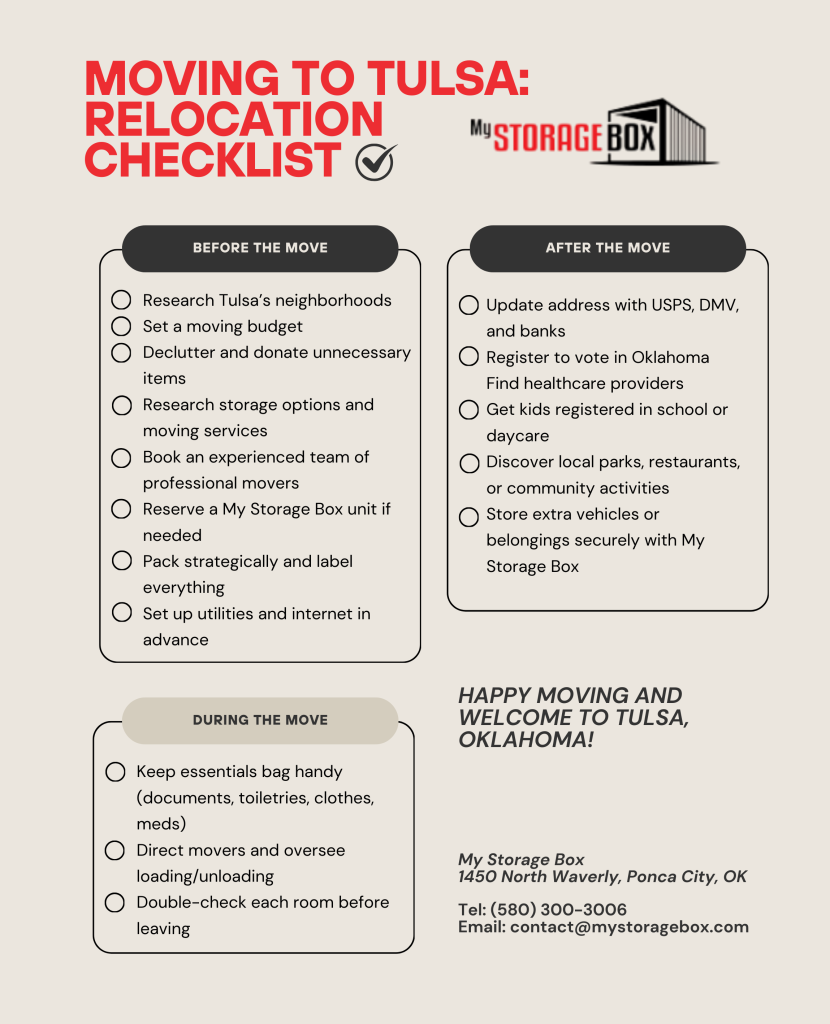
Moving to Tulsa? Here’s your relocation checklist in PDF, too, for a stress-free moving experience.

✅Research Tulsa’s neighborhoods

✅Set a moving budget

✅Declutter and donate unnecessary items

✅Research storage options and moving services

✅Book an experienced team of professional movers 

✅Reserve My Storage Box unit if needed

✅Pack strategically and label everything

✅Set up utilities and internet in advance

✅Update address with USPS, DMV, and banks

✅Register to vote in Oklahoma

✅Find healthcare providers

✅Get kids registered in school or daycare

✅Discover local parks, restaurants, or community activities

✅Store extra vehicles or belongings securely with My Storage Box

Conclusion

Moving to Tulsa, OK, is more than a change of address. You’re starting a new adventure in your life in a city that blends affordability, opportunity, and community. With its thriving job market, vibrant culture, and welcoming neighborhood, Tulsa offers plenty of reasons to feel excited about your move.

Of course, relocating takes planning. From budgeting and decluttering to setting up utilities and choosing the right school or healthcare provider, there are a lot of details to keep track of. That’s why having a reliable checklist can make all the difference.

And remember, if you need extra space for any reason whatsoever, My Storage Box is here for you! Click the link to get started and reserve a unit, then make monthly payments. Or, feel free to call us at (580) 300-3006.

How Many Moving Boxes Do You Need to Move?

How Many Moving Boxes Do You Need to Move? A Simple Guide

One of the first questions people ask themselves when preparing for a move is:

“How many moving boxes do I actually need?”

And yet, it’s surprisingly hard to answer.

Too few boxes, and you’re scrambling at the last minute. Too many, and you’ve wasted money, time, and space. The truth is, there’s no universal number that will work for everyone, but there is a reliable way to estimate what you’ll need based on your factors.

In this guide, we’ll break it down in a practical, stress-free way so you can plan your move with confidence (and fewer last-minute runs for boxes). Also, make sure to check out our move-in checklist for sound advice on what you need to do to move into your new pad!

The Short Answer: Average Moving Box Estimates

As a quick starting point, here’s a general estimate based on home size:

  • Studio apartment: 15-25 boxes
  • 1-bedroom apartment: 25-40 boxes
  • 2-bedroom home: 40-60 boxes
  • 3-bedroom home: 60-90 boxes
  • 4+ bedroom home: 90-120+ boxes

These numbers assume a mix of small, medium, and large boxes but your actual needs depend on several important factors.

Let’s take a closer look.

What Affects How Many Boxes You’ll Need?

The number of boxes needed depends on several factors, including the size of your home, the number of rooms, and the amount of stuff you have.

Your Lifestyle

Two people living in identical apartments can need wildly different numbers of boxes.

If you’re the type of person who likes to keep things around “just in case” or you have creative hobbies with equipment or supplies, then you’ll probably need more boxes than someone living a more minimalistic lifestyle.

Are your closets packed or curated? Do you have a lot of books, decor, or seasonal items?

These questions can help you understand your packing situation and help you set the right expectations. 

A maximalistic lifestyle definitely requires more boxes, so if you recognize yourself in these traits, expect to be at the higher end of the estimate.

How Long You’ve Lived There

Another important factor to consider is how long you’ve lived in your current home.

Even if it feels like you don’t have much stuff, belongings tend to accumulate over time, often without us noticing. If you’ve lived in the same place for ten years or more, it’s wise to plan for extra boxes. Basements, attics, and spare closets are especially easy to overlook, and they often hold items you won’t think about until moving day arrives.

The Number of People In Your Household

The number of people in your household also plays an important role in determining how many boxes you’ll need. More people usually means more clothing, shoes, personal items, and everyday essentials, all of which add up quickly when it’s time to pack. A home shared by a couple or a family will always require more boxes than a similar-sized space occupied by one person.

Transportation

Transportation and distance matter as well. 

If you’re moving long-distance or using professional movers, your belongings may need to be packed more securely, which can increase the number of boxes required. Longer moves often involve sturdier boxes and more casual item separation to prevent damage, so it’s worth factoring this into your packing supply estimate when planning.

Moving Box Breakdown Based on Home Size

When it comes to planning a move, one of the first things to consider is how many boxes you’ll actually need. The answer depends mainly on the size of your home, the number of people living there, and the type of belongings you own. 

While every move is unique, the following estimates can give you a starting point:

These figures are helpful as guidelines, but they are not set in stone. 

Your lifestyle, your possessions, and storage habits will all influence how many boxes you actually need. A minimalist living in a 4-bedroom home may require far fewer boxes than suggested, while a tiny studio packed with books, collectibles, or hobby items might need more boxes.

Choosing the Right Box Sizes (This Matters More Than You Think)

There are various types of moving boxes available, including small, medium, large, and extra-large boxes, each designed for specific items.

The size and type of boxes you choose can make a huge difference in how efficiently you pack and move your belongings. It’s not just about the number of boxes, but about choosing the right ones for your items.

  • Small boxes (around 1.5 cubic feet) are perfect for heavy items, such as books or small appliances. They’re easier to carry and less likely to tear under weight.
  • Medium boxes (1.5 to 3 cubic feet) offer versatility. They’re ideal for packing items like clothing, linens, and kitchen supplies. A good trick is to fill these boxes halfway with heavier items, like books, and top them off with lighter items, like towels or sheets.
  • Large boxes (2.5 to 3.5 cubic feet) are best for lighter, bulkier items. Think pillows, blankets, or stacking smaller boxes inside. They’re great for consolidating many light items in one place without making them too heavy to lift.
  • Extra-large boxes (3.6 cubic feet or more) work well for oversized or oddly shaped items, as well as for piles of lightweight belongings. Just be careful not to overfill them, or they’ll become difficult to move.

Before you start filing boxes, take a moment to assess what you actually own. Items vary in size, weight, and fragility, and your moving plan should reflect that. Knowing what you have will help you select the right type of boxes and the correct number of each size. 

By combining smart estimates, the right box types, and careful planning, you’ll be much more prepared for moving day and it will make unpacking that much easier. Also, check out our blog on drive-up storage options in Northern Oklahoma!

Specialty Moving Boxes

Sometimes standard boxes just won’t cut it. That’s where specialty boxes come in handy.

  • Book boxes: If you have lots of books, 12” x 12” boxes (roughly 1 cubic foot) keep them manageable in weight while protecting them during transport.
  • Dish barrel boxes: Fragile items like glassware and china benefit from these reinforced corrugated boxes. Always mark them “fragile” and avoid stacking heavy boxes on top.
  • Wardrobe boxes: Perfect for hanging clothes, these extra-large boxes include an internal rod, so you can move clothes directly from your closet without folding them. They save time and prevent wrinkles, making closet packing much faster.
  • Lamp boxes: They are designed to protect lamps and lampshades, which can be challenging to pack safely in standard boxes. Their tall, adjustable shape allows you to separate bases from shades and pad each piece properly to prevent cracks or dents.
  • Mirror and picture boxes: These are flat, adjustable boxes made for framed artwork, mirrors, and large photos. They help prevent bending, cracking, or shattered glass and are especially useful for oversized or delicate wall decor.

Using specialty moving boxes where needed can make a big difference in protecting your belongings and reducing stress on moving day.

When to Consider Self Storage for Your Move

Sometimes, even the best packing plan and accurate box estimates aren’t enough to make a move completely stress-free. That’s where self-storage can make a big difference. 

If your new home isn’t quite ready yet, or if you need to move out before you can fully unpack, a storage unit gives you the extra space to keep your belongings safe and organized.

Self-storage is also a smart option if you’re downsizing, renovating, or simply want to unpack gradually without feeling overwhelmed. By temporarily storing boxes and larger items, you can take your time arranging your new home exactly the way you want it while keeping your possessions secure.

Even for smaller moves, self-storage can be helpful for items you don’t use every day, seasonal belongings, or fragile items that need extra care. Knowing you have a safe place to store your things lets you focus on the move itself without the stress of overcrowding your new space.

In short, storage is a flexible, practical tool that can make any move smoother, calmer, and much more manageable.

Shipping containers used for self-storage.

Final Thoughts: Plan Smartly, Pack Calmly

So, just how many boxes do you need?

The honest answer is that it depends, but not in a way that’s impossible to estimate. What matters most is having enough boxes to pack comfortably without rushing or overloading boxes just to make everything fit.

By thinking realistically about your home, your belongings, and how you live, you can arrive at a number that works for you.

We know moving can be exciting and overwhelming, and we’re here to help. At My Storage Box, we offer secure, affordable storage solutions with 24/7 access, video monitoring, and gated entry, so your belongings stay safe every step of the way.

Ready to make your move easier? Call us at (580) 300-3006 or reserve your unit online today. Also, make sure to check out our pricing ahead of time.

Top Storage Units in Enid, OK: Affordable and Secure Options Available

Secure, Affordable Storage Near Enid, OK: Choose My Storage Box

Looking for storage units in Enid, OK? You need a place that’s secure, affordable, and hassle-free because the last thing you want is to overpay or stress about your things. Whether you’re moving, decluttering, or just need extra storage space, finding the right facility is key.

Just a short drive away from Enid, My Storage Box in Ponca City, Oklahoma, offers everything you need: secure units, great rates, and the convenience you want.

Instead of settling for limited options, it’s worth exploring why expanding your search beyond city limits can lead to better value and peace of mind. Let’s break it down together.

What to Look For in a Storage Unit in Enid, OK

With so many self-storage options, where do you even begin? The right facility should offer more than just a place to stash your belongings. Before you commit, here’s what to consider:

  • Security: This is a non-negotiable. Your belongings deserve the best protection, so look for a facility with gated fenced access, surveillance cameras, and bright lighting to keep everything safe.
  • Size options: Whether you’re storing seasonal decor, bulky furniture, or business inventory, the right unit size matters. Choose a facility that offers flexibility so you’re not stuck paying for space you don’t need or scrambling for more.
  • Affordability: No one wants to overpay for storage. Compare pricing, watch for hidden fees, and look for promotions to get the best deal.
  • Accessibility: If convenience is a priority, drive-up access and 24/7 availability can make a world of difference. Make sure the facility’s access hours and layout fit in your life and schedule.
  • Temperature-controlled units: Climate control is particularly important when you’re storing electronics, antiques, or important documents. Make sure the facility you choose is waterproof and safe from the elements.

Why Consider My Storage Box in Ponca City?

While there are local options in Enid, My Storage Box in Ponca City, OK, offers top-tier features at a great value for your money. Here are some reasons why making the trip is worth it:

Convenient and Hassle-Free

Ponca City is very close to Enid, and My Storage Box makes the trip worthwhile with features designed for your convenience. We provide drive-up access so you can easily load and unload your items with no hassle. Our online bill system allows you to manage your account effortlessly from anywhere. Plus, our friendly customer service will help you with whatever you need, whether you need assistance choosing the right unit size or just need driving directions. Our access hours are 24/7/365, 7 days a week, so you can visit your unit anytime that suits your schedule.

Shipping containers used for self-storage.

Secure and Reliable Storage You Can Trust

You can’t put a price on your peace of mind, and that’s exactly what we deliver. That’s why we prioritize top-tier security at My Storage Box. Our fully fenced and gated facility is equipped with a state-of-the-art camera system to ensure that only authorized individuals enter the site and keep your belongings protected at all times. So no matter how long you’re storing your things with us, you can trust that they’re in the right hands.

Affordable Storage Options

We understand that storage fees can add up fast, which is why we keep our prices competitive without cutting corners on quality or security. You’ll find a variety of budget-friendly options, transparent pricing with no hidden fees, and special promotions to help you save even more. Plus, we offer a free lock with every move-in so you can secure your unit right away at no extra cost.

Storage Unit Sizes to Fit Your Self Storage Needs

Whether you need a small space for seasonal items or a large unit for business inventory, we have a size for everyone:

  • 8×10 Storage Unit – Ideal for small furniture, boxes, or business supplies.
  • 8×20 Storage Unit – Fits the contents of a small apartment or office space.
  • 8×40 Storage Unit – Great for storing furniture, appliances, or larger business inventory.
  • 10×40 Outdoor Parking (Car, Boat, RV) – Our parking options offer a convenient way to safely store your vehicles.

If you’re unsure which size is for you, our team is happy to help you find the perfect fit.

What Our Customers Are Saying

Customer satisfaction speaks for itself. We’re proud to have a 5-star rating on Google, with reviews highlighting our secure facilities, convenient location, and unbeatable prices. Our commitment to excellent service makes us a trusted choice for the Enid, Oklahoma, community and beyond.

Make the Right Choice for Your Storage Needs

If you’re on the hunt for storage units in Enid, OK, don’t limit your options. Choose a facility that offers more for your money. My Storage Box is conveniently located in Ponca City and gives you secure, affordable, and flexible storage without the hassle. Whether you need extra space for your personal belongings or business supplies, we make storage easy and stress-free.

Ready for a great deal on storage? Contact MyStorageBox.com to check availability and reserve your unit today!

Top Storage Units for Students: Convenient Solutions for College Life

Simplify College Living: Top Storage Units for Students

Managing your belongings and space is a reality of college life. Storage units for students provide a convenient solution to safely store your items.

As a fresh college student, there’s a lot going on for you and plenty on your mind. While you’re gearing up for what might be the most exciting and nerve-wracking time of your life, the last thing you want to stress about is storage. However, that’s one of the realities of adult life you’re stepping into — managing your belongings and your space.

Not to worry, though, because My Storage Box has you covered with convenient solutions for your student storage needs. In this blog post, we’ll help you understand how to find the best storage unit as a student, whether you’re settling into a new dorm or transitioning between semesters. Let’s dive in!

Shipping containers lined up for use.

Why Is Storage Important For Students?

Student storage provides a secure, accessible solution for college students to store their belongings during school breaks, summer, or while studying abroad.

Here are some of the main benefits of college student storage:

  • Peace of mind and reduced stress – College life is stressful enough as is. There’s no reason to have the added burden of clutter on top of that. That’s why student storage is so important and helps take some pressure off.
  • Convenience and flexibility for busy students: Accessible storage units let students retrieve their belongings whenever needed, making it much more convenient.
  • Added safety and security: Dorms may not be the safest place for valuable items, so it’s smart to store them in a storage unit. Secure storage units protect valuable items from damage, theft, or loss, and are great for students who have moved away from home.
  • Allows for extra space in your dorm room – Shared houses and university dorms often don’t have enough space for everyone’s stuff. Renting a self-storage unit can help keep your room neat and organized — key for staying focused and productive in college.
  • Practical for summer months – A self-storage unit offers practical solutions for your stuff until the next semester, freeing you from the hassle of going back and forth with packing and unpacking.

What Is the Best Self-Storage for Students?

The best self-storage for college students is the one that meets their unique needs. That means it addresses the key factors: location, size, affordability, and safety. 

Man taping up box with packing tape.

Ideally, the facility should be close to you so you don’t have to travel far to access your belongings. It should be near your university campus, making it easy for you to get your stuff during busy periods like finals or when moving in and out between semesters. With these factors in mind, you’ll want a storage solution that makes student life easier from day one.

At My Storage Box, we offer student-friendly storage solutions that can easily fit the contents of a three- to four-bedroom house, perfect for sharing with roommates or keeping all your essentials safe over the break. We keep all our units extremely secure, gated, and keypad-accessible so you can come and go as you please, while also giving you the peace of mind that your stuff is in the right hands. 

Our goal is to give you the best self-storage experience so you can focus on this extraordinary new part of your life. 

How to Rent a Storage Unit as a Student?

In case you need extra help with renting out your first self-storage unit, here’s a mini guide to make sure you cover all the important steps. 

Look for Key Features for Your Needs

Let’s get the most vital step out of the way first – make sure you know your exact needs. 

Before you even start exploring storage facilities near you, it’s important to know what you’ll be storing. This will help you understand the unit features you should look out for.

There are various unit sizes available to fit different needs, ranging from small units that accommodate single dorm rooms to large units that can accommodate shared apartments. These units are ideal for storing furniture, clothing, appliances, and more.

Then there’s the key feature that should be non-negotiable for every storage company: 24/7 access and security measures. It provides students with convenient access to their belongings at any time. It typically includes features like video recording, gated entry, and on-site staff.

Browse Storage Companies in Your Area

The next step is to find several potential companies near campus that fit your needs. You can either search online or go the tried-and-true route of word of mouth. Some older students on your campus might already be using a local storage unit, so don’t be shy and ask away! Once you’ve identified potential storage providers, either visit their facilities to see how they operate or rent space online. 

Understand Rental Periods and Payment Options

One more step before you rent out a space: understand the available rental periods and payment options. Most storage companies offer month-to-month rentals, which are ideal for summer breaks or short-term storage needs. But this flexibility also allows you to plan for the long term and adapt your storage plan according to your academic needs.

Look for facilities that provide multiple payment options, including online payment portals and automatic billing. This is especially helpful for busy students who want easy management without worrying about missed payments.

Pack and Store Your Belongings

Almost done! Now it’s time to pack your stuff

You may think this is not such a crucial step, but trust us, it’s more important than you think, particularly if you’re looking to save money. 

Smart packing helps you avoid overpaying for extra space you don’t need. Plus, it saves you the hassle later on when you’re juggling classes and exams, and you can just quickly come and go to retrieve the items you need.

Use sturdy boxes and packing materials to protect items. This ensures that everything is stored safely, efficiently, and systematically.

Label and organize boxes for easy access. Future ‘you’ will thank you when you’re able to quickly find what you need without stress.

Finally, consider renting climate controlled storage unit for sensitive items such as electronics, important documents, photographs, or artwork. This extra protection ensures your valuables remain in pristine condition, regardless of the weather.

Final Thoughts

University life is one of the most exciting chapters of your life, and making the most out of your tiny dorm room can help you fully enjoy it. Instead of getting drowned in unnecessary clutter, student storage offers the ideal solution to keep your space neat and your mind clear, allowing you to focus on what truly matters — your studies and experiences.

My Storage Box in Ponca City, Oklahoma, is here to meet all your storage needs. You can contact us 24/7, 7 days a week, and our friendly staff will be happy to help you find the right storage unit for your belongings!

The Best Suburbs of Wichita to Live in for 2026

The Best Wichita Suburbs for Families and Professionals to Consider

Wichita, Kansas, is a fine city in the Great Plains, poised for rapid growth over the next decade. In fact, some researchers anticipate a 17% growth in the Wichita Metro between now and 2035, outpacing the national average of 12% by a fair margin. It’s not hard to understand why: Wichita scores roughly 10 percentage points below the national average on the cost-of-living index, making it an extremely affordable place to live. Located directly on Interstate 35 (I-35), traveling to Oklahoma City, Dallas/Fort Worth, and even on to Austin, San Antonio, Houston, and even the beaches of Coastal Texas is a breeze. If you want to go east or west, it is an easy drive up to I-70 and take it to either coast. 

But living downtown or in the city isn’t always everyone’s cup of tea, and we get it. The suburbs are quieter with less crime and more amenities, and Wichita has plenty of nice suburbs. Let’s take a look at these and help you find out which one is the best fit for you and your family. 

Overview of Wichita Suburbs

Wichita is the largest independent city in Kansas and is nearly twice the size of the state’s second-largest city. Wichita is home to iconic companies like Cessna, Beechcraft, and Learjet. Also, Wichita is the original home of Pizza Hut pizza! 

Wichita’s population is just shy of 400,000, although the entire metroplex is over 650,000, so it has all the amenities of major U.S. cities, a full-service airport with daily flights, and maintains the feel of a much smaller city. Also, Wichita’s cost of living index is roughly ten points below the national average, meaning your dollar goes a lot farther.

The great thing about Wichita is the way it is built to make it easy for people to get from one side to the other. It is an easy city to get across, with a sprawling main drag that sometimes spans six or seven lanes. This is Kellogg Avenue, which is also U.S. Route 400 and Kansas State Highway 54. With this massive roadway, along with I-35/135/235 and a few other main arteries, you can get across town easily.    

Wichita suburbs offer a range of options for families and professionals, from affordable housing to top-rated schools and community amenities. Wichita has close to 20 suburbs, depending on what you consider a suburb. These towns and small cities range in size from around 3,000 to about 25,000 and are some of the most desirable places to live in the metro. The suburbs are known for their safe and welcoming communities, making them an attractive choice for those looking to relocate.

With easy access to downtown Wichita, the suburbs offer the best of both worlds: a suburban lifestyle with urban amenities. Even downtown Wichita is a relatively short drive from most suburbs, thanks to the simple, fast roadway system. If city life isn’t really your cup of tea in the Wichita area, it’s okay; we’ve got you covered with the best suburbs in the metro. There are a number of excellent school districts in the highest-ranked suburbs of the Wichita area. 

Education

One thing that is almost universally accepted as the ultimate bellwether of suburban development is the educational outlook. Whether you are looking for an independent school, a classical school, or private schools nearby, these are all important considerations. 

Of course, most people are not seeking top private schools, or even nearby private schools, so they will congregate near public schools with high scores and rankings. 

Top-Rated Schools in Wichita Suburbs

Here is a list of the highest-ranking schools in the Wichita area, along with the town they are in. 

Park Hill Elementary School in Derby, Kansas

Located to the south of Wichita, Derby is one of the largest and most popular suburbs in the Wichita area. Derby is a popular town for service members to call home, too, since it is just outside of McConnell Air Force Base. 

Park Hill Elementary in Derby is a great place to start. According to popular school-review website Niche, Park Hill Elementary scores a solid B+. It comes in at the 215th best public elementary school in Kansas out of 703 surveyed.

Maize Central Elementary School (A−) in Maize, Kansas

Maize lies opposite Wichita. Maize is a small suburb with a population slightly under 6,000, which keeps it with a small-town appeal and charm that gets lost in some of the other cities.  Surrounded by rolling prairie, Maize is a great place to call home. 

Maize Central is also a great place for your kiddos to call their academic home. Niche gives Maize Central an A-and ranks it as the 111th-best public elementary school in Kansas. 

Derby North Middle School (B+) in Derby, Kansas

Back to Derby, we find Derby North Middle School. Derby North scores a B ranking and has a student-teacher ratio of roughly 14 to 1. This school is a large middle school with over 800 students, feeding into Class 6A Derby High School.

Robert M. Martin Elementary School (A) in Andover, Kansas

Robert M. Martin Elementary in Andover is a quality public school, with over 63% of students scoring proficient in reading and math. This is higher than both the district and state averages. In fact, USNews.com ranks Robert M. Martin Elementary as the second-best elementary school in the Andover Public Schools District and the 15th best in Kansas.

Abilene Elementary School (A) in Valley Center, Kansas

Another excellent school in the Wichita area is in Valley Center on the north side of the city. Valley Center Elementary nabs a solid A rating from Niche.com with 75% proficiency rating in math and 65% in reading. 

Wheatland Elementary School (A) in Andover, Kansas

One of the very best schools in Kansas is in the popular, quaint Wichita suburb of Andover. Wheatland Elementary School is the #6 best grade school in Kansas according to the U.S. News and World Report. Proficiency levels are nearly 80% for math and a little over 70% for reading, making it an all-star school for your kids. 

Don’t overlook Wheatland Elementary School as a top educational destination for your kids. 

Andover Middle School (A) in Andover, Kansas

Andover has really dialed in education as a priority, and it shows. Andover Middle School ranks 12th among Kansas middle schools, out of 326. Over half of the students are proficient in math and science. Again, Andover is a great place to be in Wichita. 

Maize South High School (A−) in Maize, Kansas

Rounding out the city’s different areas is Maize. Maize is on the west side of Wichita, and Maize High School, with an enrollment just shy of 1,100, puts it in the 6A bracket, the largest in Kansas. 

Maize is a good option for parents who still want their kids to have access to a state-of-the-art, large high school without some of the less savory problems associated with large inner-city schools. 

Pray-Woodman Elementary School (A−) in Maize, Kansas

Pray-Woodman in Maize earns a B+ rating and is the #157 school in the state out of 703 schools. It sits comfortably in the top quarter of grade schools in the state, and with a good high school in the district, Maize is a fine place to call home. 

Family-Friendly Suburbs

With around ten suburbs closely nestled to Wichita, you have a lot of great places to choose from. Yet, all of the iconic things that make Wichita such a cool place to live are never far away. The famous Keeper of the Plains, Botanica, Old Cowtown, the Kansas Aviation Museum, the Great Plains Nature Center, and a whole lot more make Wichita a top place to call home. You can pick a classical school if you want, or one of the many excellent school districts in the suburbs to settle down in.  

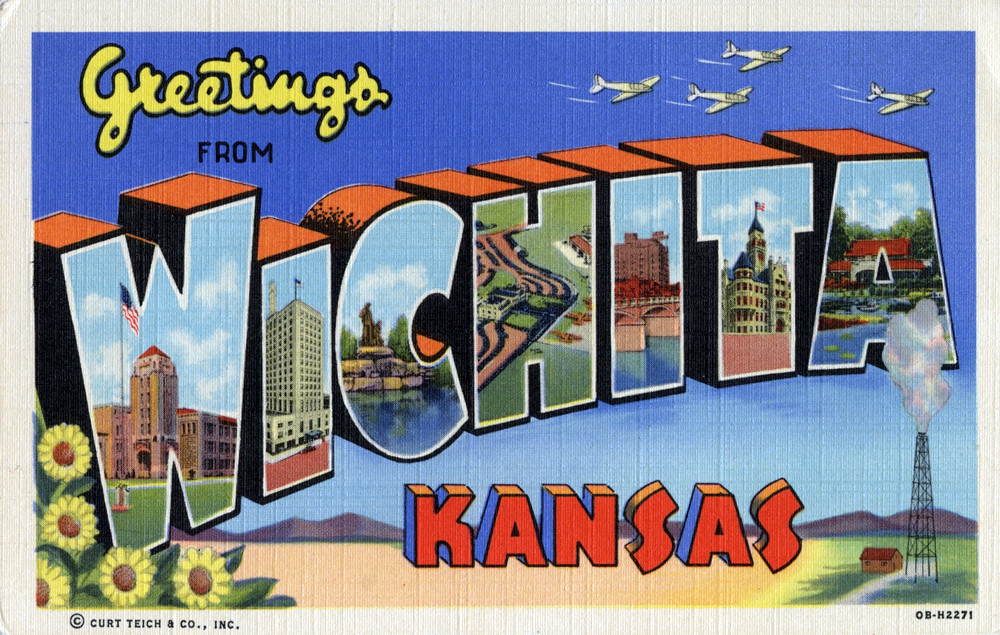
Greetings from Wichita, Kansas – Large Letter Postcard” by Shook Photos is licensed under CC BY 2.0.

Andover, Kansas

Andover is one of the nicest small cities in Kansas. That is mostly a personal anecdote, but as a native Kansan who has lived here for 38 years, I know a thing or two about the state. Some towns are wonderful, while others seem content to just exist. 

Andover is a wonderful place to grow up and grow old. Wichita is more than enough city to support anyone’s dreams. With a heaping helping of cutting-edge industry and manufacturing, and lots of high-quality schools nearby, Andover residents can pursue college degrees while enjoying the quiet and extra space that a small city affords. 

Andover is home to excellent schools, including Andover Middle School (A) and Wheatland Elementary School (A). All of the schools in the district receive high marks from trusted sources like Niche and U.S. News and World Report. 

Beautiful parks and green spaces, perfect for outdoor activities. Even though we are enveloped in a nasty winter storm at the moment, Andover and the rest of South Central Kansas actually enjoy a very nice, long, warm season. There are really only a couple of cold months here (January and February), and nearby Southeastern Kansas is well known for excellent fishing in the waterways. There are ample lakes in the area, and just a couple of hours to the Southeast gets you into the Ozarks.

Strong community ties make it easy to feel at home in a small city with a population of just under 15,000 that still feels like a sleepy, quaint small town. Located just 15 minutes from downtown Wichita, it’s got access to everything you want without being burdened by the noise and traffic. 

Andover High School is a smaller high school (4A), which gives your kids a quieter experience with more one-on-one teacher-to-student opportunities than the much larger schools in the area. Andover is definitely one of the best suburbs in the Wichita area. 

Derby, Kansas

With its close proximity to McConnell Air Force Base, Derby is a very popular small town for locals and military families alike. McConnell is one of the major employers in Wichita and accounts for somewhere in the ballpark of 10,000 direct and indirect jobs in the area and hasa $1 Billion economic impact on the community. The base is on the outskirts of Wichita to start with, so many military members choose to live in the suburbs on that side of Wichita rather than in the city itself. 

Derby is a traditional suburb in the sense that it maintains small-town charm yet with one of the largest high schools in the state, your kids have the chance to access elite athletics programs (Derby has a rare “threepeat” of 6A football championships from 2017-2019 in the largest classification in the state, plus a fourth championship in 2013), and elite academics. 

Ike’s interstate system runs right outside of Derby, making it easy to get up to Topeka or Kansas City, or connect to I-70 to head out west to Denver and beyond. Or, you can get on I-35 south and head all the way to the beaches of South Texas if you want. 

Derby has a low cost of living with lots of affordable housing options, making it a great choice for growing families. The median home price fluctuates between about $277,000 and $284,000, depending on the source, which is far below the national median of around $406,000. With a lively city so close and mortgages that are so much less than much of the country, it’s no wonder Derby is a top suburb of Wichita. 

Derby is home to lots of parks and recreational facilities, including Rock River Rapids Aquatic Park, and at only about 15-20 minutes away from downtown Wichita, you can be in the thick of things in no time. 

The weather grade for Derby is consistent with Wichita and earns a B+ on Niche.com, and as a native Kansan, I agree! This region of America has a humid subtropical climate, characterized by warm and humid summers and cold winters. According to the Köppen-Geiger classification, the climate type in this region is Cfa, which indicates a climate with no dry season and warm summers. Here are some key points about the climate of the Wichita area:

  • Humid Subtropical Climate: Wichita experiences hot and humid summers and cold, snowy winters. The city’s climate is characterized by significant seasonal variation.
  • Average Temperature: The average temperature in Wichita is 14.4 °C | 58.0 °F.
  • Precipitation: The city receives an annual precipitation level of 924 mm | 36.4 inches.
  • Warmest Month: July is the warmest month with an average high of 92.5°F (33.6°C).
  • Coldest Month: January is the coldest month, with an average low of 26.6°F (-3°C).
  • Rainfall: May typically experiences the highest rainfall, averaging 2.8 inches (71mm), while December generally registers the least, at around 0.39 inches (10mm).
  • Snowfall: January and February are peak periods for snowfall, making them challenging months for outdoor activities.
  • Daylight Hours: Daylight hours vary from 9.9 hours in December to 14.7 hours in June.

Maize, Kansas

Located on the opposite side of Wichita from Derby is Maize, a small city with a population of just under 6,000. You really do get a small-town feel in Maize because it is a small town. The weather grade is a B+ for the same reasons as Derby and Wichita.

For recent high school graduates or working adults alike, there are ample opportunities to pursue college degrees from top private schools like Friends University or major state schools like Wichita State University. You can expect college-town amenities within easy reach of Maize, as it is only about 15 minutes from downtown Wichita. But if you want quiet and extra space to stretch out and admire the open plains, the Maize is a great place. 

The median rental price in Maize is about $1,500, according to Zumper, which is about 20% lower than the national average. Who could ask for more? Small town feel, located in the air capital of the world, and easy access to Ike’s interstate system. 

Family-oriented lifestyle with a focus on active living with a mix of modern amenities and small-town charm. There are plenty of single-family homes to choose from, and all areas of Wichita still beat the national average by up to 10 percentage points. 

Affordable Suburbs

You can definitely consider all of the suburbs of Wichita to be what you’d call affordable. Whether you want to live the high life in the city or you want to settle onto a little farmstead and raise chickens and goats, Wichita has a suburb to offer you, either at a very affordable price point. 

Haysville, Kansas

Haysville is located on the south side of Wichita, right on the opposite (west) side of Derby off of I-35. Haysville is home to around 11,000. Median home prices are hovering around $200,000, but a quick look at Zillow showed me there were plenty of houses in the $130,000 range. 

  • Median home price: ~$200,000. 
  • Affordable housing options make it a great choice for first-time homebuyers
  • Good schools, including Haysville High School

Valley Center, Kansas

Valley Center is located north of Wichita on I-135, just past Bel Aire and Park City. Valley Center is also reasonably close to Newton, in case your work takes you there. 

  • Median home price: ~$239,000
  • Affordable housing options make it a great choice for families
  • Good schools, including Valley Center High School

Valley Center is a small suburb with just over 7,000 residents, making it a great place to call home. Since it is fairly far outside of Wichita, you can get far from the city lights to enjoy the sprawling prairie and find some acreage to buy or build on.

Parting Thoughts

Wichita is a great city to live in or live near. Home to several four-year universities and excellent trade schools like Wichita State University Tech, you can attend an excellent primary school in a Wichita suburb, graduate, and then move on to learning a valuable skill without the necessity of moving away. 

It’s also a great place to move to. Wichita has tons of opportunities for entrepreneurs and people looking for something new or a good place to stretch their dollar. 

The Top Tulsa Suburb Choices for Families in 2026

Top Tulsa Suburbs for Families: Your Guide to the Best Areas

Tulsa is fast becoming a destination for people who have decided to call it quits in areas that have outpaced their budgets. Tulsa has been coined the Cultural Capital of Oklahoma thanks to extensive cultural offerings. It has also been dubbed “the San Francisco of the Midwest” by some, but also retains the monikers of “Oil Capital of the World” and “Magic City,” a throwback to Tulsa’s rapid economic growth and prosperity thanks to the discovery of oil in the region. 

When you drive through Tulsa, you will see reminders of its boomtown past all over the place. But Tulsa didn’t just spark a flash in the pan and fizzle out. Tulsa is a great city to grow up in and grow old in, but living in the middle of the city isn’t for everyone. Thankfully, there are lots of great suburbs to choose from in the Tulsa metro, so let’s take a look at a few. 

Introduction to the Tulsa Metropolitan Area

The Tulsa metropolitan area is a great place to raise a family, with a range of suburbs offering excellent schools, outdoor recreational opportunities, and a growing economy. Tulsa has really exploded as a cultural hub, and it is ideally located near some of the most beautiful areas in America. Tulsa has several world-class lakes within an hour or two, and it is located at the western edge of the Ozark Mountain Range. If the outdoors are calling, Tulsa answers. 

From the Arkansas River to the surrounding suburbs, there’s something for everyone in the Tulsa area. The Arkansas flows beautifully through the heart of Tulsa, providing great fishing and recreational opportunities. 

Tulsa is home to several colleges and universities, including the world-famous Oral Roberts University, the University of Tulsa, and the Spartan School of Aeronautics, among others. With natural resources to spare, manufacturing, and a laundry list of white-collar opportunities, Tulsa is an awesome place to call home.  

Top Suburbs for Families

Tulsa is surrounded by a crop of excellent suburbs with just about every amenity you could ever ask for. Here are some of the best ones by the books. 

Jenks

Jenks is a storied suburb of Tulsa that has produced a ton of football stars in the state over the years. Jenks is also one of the fastest-growing cities in Oklahoma; from 2010 to 2020, Jenks grew by an astounding 54%, and it is still growing fast. 

Jenks is a suburb of Tulsa with a population of around 27,000 and a median income of $101,767. It’s ranked among the best suburbs to raise a family in the Tulsa area, with excellent schools and a low cost of living.

Jenks is located along the Arkansas River, offering plenty of opportunities for outdoor recreation. Tulsa is well-designed with a beltway and major highways cutting through it, so getting across the city is a breeze. You can live in Jenks and be in the heart of Tulsa in just minutes. 

Broken Arrow

Much larger than Jenks, Broken Arrow is the largest suburb of Tulsa and, in itself, a good-sized city with around 114,000 inhabitants. In fact, it is the fourth-largest city in the State of Oklahoma and accounts for roughly one-tenth of the Tulsa metropolitan area, which numbers just over one million. 

Originally a railroad town, Broken Arrow is now a very modern, smart city home to loads of manufacturing. It is the third-largest manufacturing concentration in the state and is still in the middle of one of the largest oil and gas markets in the world. This Tulsa suburb has it all: great jobs, proximity to downtown Tulsa, and a cost of living well below the national average. 

Sand Springs

On the far west side of Tulsa lies Sand Springs. Sand Springs sprawls across three counties (Osage, Creek, and Tulsa). With a population of approximately 20,000, it is slightly smaller than Jenks and has grown by 5.1% over the past decade. 

Sand Spring is on the edge of the Tulsa metro area with a median home price in the ballpark of $248,000. This price is a moving target, but it’s still roughly 40% below the national average. If you want the amenities of a real city but a lot less noise, then Sand Springs is a great place to be part of the city without being in the city. 

Owasso

A large percentage of the Tulsa population lives in the suburbs, and the best suburb in the greater Tulsa area is always a popular debate. Residents are occasionally deeply territorial, especially when it comes to high school football. 

The concentration of parks, proximity to downtown, and other Tulsa-area attractions make Owasso a top pick. Owasso is north of Tulsa and located only a few minutes from Tulsa International Airport, one of Tulsa’s largest employers. Owasso is located in Rogers County and Tulsa County and is a rapidly growing suburb in the Tulsa region. 

Image courtesy of the City of Owasso.

Coweta 

Back to the south side of Tulsa, just down the road from Broken Arrow, you’ll find the smaller suburb of Coweta. At around ten thousand people, Coweta is a small town at heart but it is only 30 minutes from the heart of downtown Tulsa. This is a nice buffer distance from the big city, while giving you lots of room to stretch out.

Small enough to feel like home with local restaurants, parks, and a tidy downtown district, residents enjoy small-town living situated south of Tulsa. You can have your real estate agent find land there, settle down in a country church, and live life to the fullest in Coweta. Make sure to check out the Coweta Chamber for news and events. 

Kiefer

Kiefer is the smallest town on the list with a population of just over two thousand, making it not only feel like a small town, but it is a small town. Kiefer is an old oil town that never really grew all that much, even though it is just about to be swallowed up by Glenpool and Sapulpa. Adjacent to Glenpool, and a little south of much larger Jenks, Kiefer gives you an actual small town in the Tulsa metro area.  

Sapulpa 

Finally, we have Sapulpa. Interstate 44 runs directly through Sapulpa, giving it tremendous access to not only all of Tulsa, but everywhere else in the nation if you want it. You can get to Oklahoma City in about 90 minutes, and from there you can get just about anywhere. Of course, you don’t have to go anywhere; Tulsa has it all. 

Fine arts, culture, jobs, and cheap real estate. Sapulpa is only minutes from downtown Tulsa, but it is also close to several high-quality lakes and the Arkansas River. 

Affordable Suburbs

The great thing about the greater Tulsa metropolitan area is that the entire place is cheaper than the rest of the nation by a fair amount. It doesn’t matter which suburb you pick because all of them beat the national average.     

Housing is over 20% below the national average, and transportation is almost 15% below. Healthcare is a staggering 21% cheaper. If you are moving from San Francisco, you can expect your cost of living to be over 90% less than in the Bay Area. 

Washington D.C.? Almost 50%. Nearly 60% less than Boston. All of these states are courtesy of Salary.com. 

If you are moving to Tulsa to save money, just pick a suburb based on aesthetics or nearness to city attractions. 

Suburbs with Excellent Schools

As with all major cities in the U.S., the best public schools are not in the city itself but in the suburbs, and the Tulsa area is no exception to this at all. 

Jenks

Jenks has an excellent school system, scoring a fantastic A+ rating from Niche.com. In fact, it is the #1 school district in the entire state, and it is also the #1 school district for athletes in the state. If you have athletically gifted children, you should definitely consider Jenks. They will get a solid academic experience and will have the best possible exposure to great coaches in Jenks. And this is nothing new: Jenks was notoriously good when I was a high school athlete in neighboring Kansas 25 years ago! 

They have been building a tradition of athletic greatness for decades and feeding top-tier talent straight to OU and OSU. 

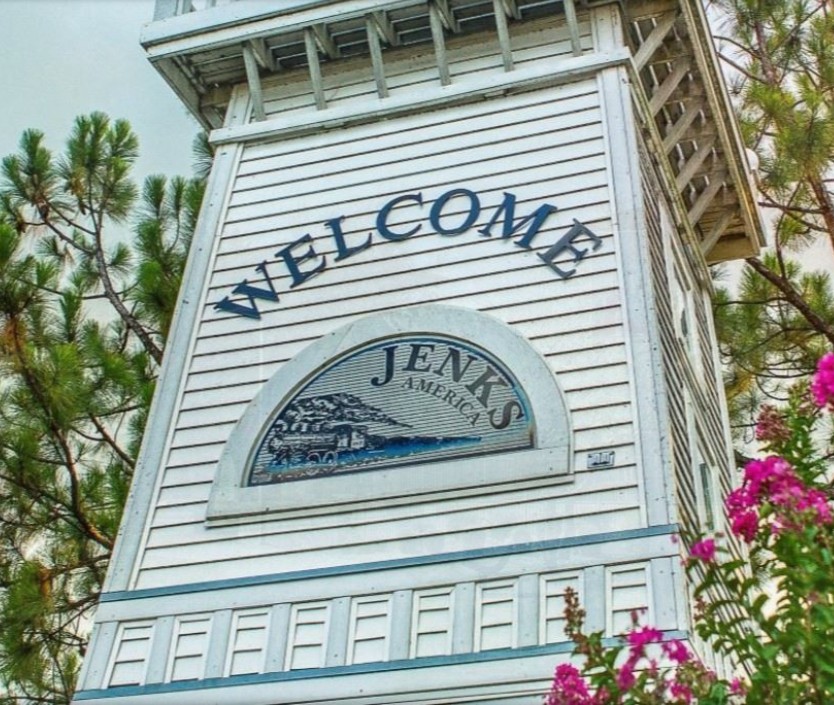
Image courtesy of the City of Jenks

Broken Arrow

Crosstown rival Broken Arrow is no slouch. While slightly lower on the totem pole (#8 in athletics and #25 in overall ranking), Broken Arrow is a great destination. One thing that I really like about Broken Arrow is that it is further away from Tulsa proper, so if you really don’t want to be that close to the city, but you don’t want to live two hours away from Costco. 

Broken Arrow is a little pricier than Tulsa proper, as all suburbs usually are, but it is still well below the national median average. 

Owasso 

Tulsa really is a hotbed of incredible athletes, and the local school districts have catered to this phenomenon. 

On the north side of Tulsa, between Tulsa and Bartlesville, is Owasso. Owasso is the #3 best district in the state for athletes and the 18th best overall school district. 

Also, with a cost of living around 15% below the national average, Owasso is a very attractive place to live. 

Suburbs with a Growing Economy

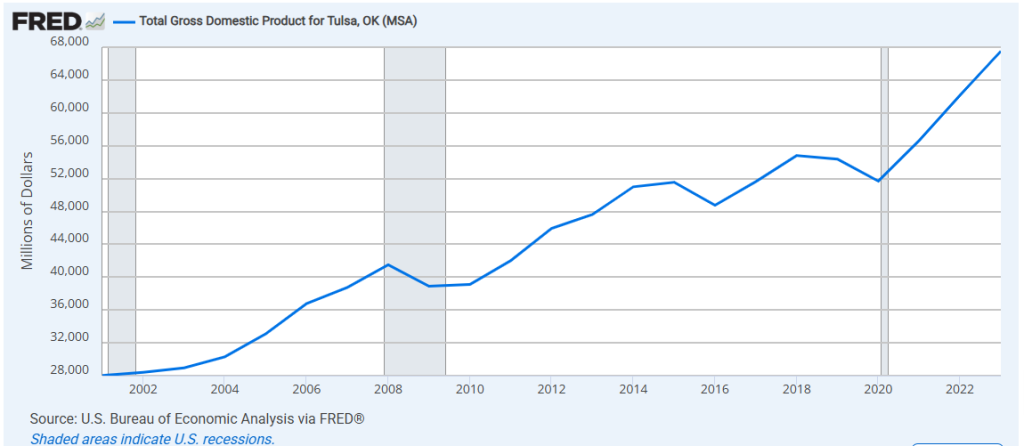
Tulsa itself continues to outpace national economic growth, and the Tulsa area accounts for nearly one-third of Oklahoma’s economy. This is a staggering statistic, considering the products across Oklahoma, including oil and gas, cattle and other livestock, and crops.  

Since Tulsa is a relatively easy city to traverse, you can simply pick one based on the other salient characteristics that you like about it. You can choose a neighborhood you like and know that you are no more than 30 minutes from anywhere else in the metro. 

Final Thoughts

Tulsa is one of the hottest places to live right now, and that trend isn’t going anywhere. With arts and culture at your fingertips, highly affordable housing, and loads of jobs, not to mention excellent school districts and incredible athletics, all you need to do is pick the suburb you like and go with it. 

Also, make sure to keep tabs on My Storage Boxes’ new locations. We are planning new locations and will post locations as they come online!

Mandatory 2026 Winter Storage Tips for Everything Outdoors

Winter Storage Tips 2026: Best Practices to Protect Your Outdoor Belongings

As the days get shorter and temperatures drop, it’s time to turn your attention to all the things you keep outside. Patio furniture, sports gear, tools, even vehicles, everything that’s been living outdoors during the warm months needs a plan before winter rolls in. If you leave it out in the elements, you risk mold, cracking, rust, and costly damage that’s often avoidable with a little bit of prep.

The golden rule of seasonal transitions is simple: store things clean and dry. A well-organized garage, shed, or secure storage unit can protect your gear from moisture and freezing temperatures, keeping it in perfect shape when you need it again in the spring.

Below we’ve rounded up essential 2026 winter storage tips for everything outdoors, designed to help you get organized, avoid damage, and make next spring’s unpacking a breeze. Let’s dive in!

Where Can You Store Items During Winter?

Before diving into the how, let’s talk about where to store everything once the temperatures drop. The best winter storage location depends on what you’re storing, how much space you have, and how well the area protects against moisture and freezing conditions.

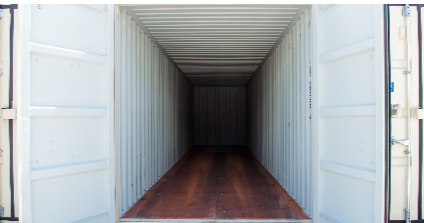
Interior of a shipping container for self-storage.

At Home: Garage, Sheds, Basement

If you have a garage or shed, that’s often the most convenient option. These spaces are ideal for storing bikes, tools, and other small outdoor items, as long as they remain dry and well-ventilated. Add weatherstripping to doors and windows to keep cold air and moisture out, and elevate items off the floor using pallets or shelving in case of melting snow or leaks. Basements can also work for indoor storage, especially for cushions or sports gear, but make sure they’re not damp.

Off-Site Storage Units

If space is tight at home, or you’re storing something large like a vehicle, RV, or full patio set, renting a storage unit is your best bet. Storage units also add a layer of security and convenience: you can access your belongings anytime without sacrificing garage or driveaway space.

Covered or Outdoor Storage Lots

For larger vehicles, like boats or RVs, covered or outdoor storage lots are a cost-effective alternative. While they don’t offer full climate control, using high-quality covers and properly preparing your vehicle will still protect against snow, debris, and UV damage.

No matter which option you choose, the key to ensuring that your storage space is clean, dry, and protected from moisture. That’s the foundation of everything else that follows.

Garage Organization

For many of us, the garage is the first place things end up when the weather changes. But without a clear system, it can quickly turn into a maze of half-stacked boxes, tangled cords, and random gear leaning against every wall. Winter is the perfect time to give this space a clean reset.

Start by looking up. Overhead racks and ceiling-mounted shelving units are fantastic for getting bins, containers, or lightweight seasonal decor off the garage floor. This frees up valuable ground space and helps keep everything dry if the floor gets wet.

Use your wall wisely. Wall-mounted systems, like slatwalls with adjustable hooks, are game-changers. You can hang bikes, skateboards, and tools so they’re both secure and easy to grab later. 

Designate zones. Assign areas for different categories: sports gear, tools, garden equipment, etc. Not only does this keep things organized, but it also speeds up the Spring setup.

If you use your garage for winter sports gear, pick a dry, well-ventilated corner to store skis, snowboards, or hockey sticks. Keeping them off the floor and away from dampness helps prevent rusted edges or warped boards.

A clean, organized garage sets the tone for the rest of your storage process. It gives you a clear view of what you actually own, which makes it easier to declutter before winter really sets in.

Sports Equipment Storage

Sports gear often gets shoved into corners or closets at the end of the season, but that’s exactly how mold, rust, and unpleasant surprises happen. Whether it’s summer camping gear, bikes, or winter sports equipment you’re about to bring out, give everything a thorough clean and let it dry completely before putting it away.

  • Wipe down and air-dry tents, life jackets, helmets, and pads before storing to prevent mildew.
  • Lubricate metal parts on bikes or scooters to prevent rust during cold, damp months.
  • Use vertical storage like hooks or racks to keep skis, snowboards, and paddles upright and spaced out. This encourages airflow and prevents warping.

For vehicle tires or recreational vehicles like ATVs, put tire covers to protect against UV rays and temperature swings. If you’re storing small engines or gas-powered tools, add fuel stabilizers and run the engine for a few minutes. This prevents sticky resin deposits and clogs when you fire things up in the spring. 

These steps don’t have to take long, but they pay off when you pull everything out in spring and find it exactly as you left it.

Vehicle Storage

Winter can be harsh on vehicles. Whether it’s a car, motorcycle, ATV, or RV, simply throwing a cover on and hoping for the best isn’t enough. 

Indoor vs. Outdoor Storage

If you have indoor space, use it. A dry place or a secure storage unit protects your vehicle from snow, freezing temperatures, and critters seeking shelter. For RVs, winterizing the plumbing by draining the water system and adding antifreeze is essential to avoid burst pipes.

If you don’t have room at home, a storage facility with covered or waterproof options is an excellent alternative for keeping your vehicle in top condition until spring.

Essential Tips for All Vehicles

  • Wash and wax the exterior to create a protective barrier.
  • Check and top off all fluids.
  • Inflate tires to the recommended pressure.
  • Choose a breathable, weather-resistant cover to protect against snow, sap, and bird droppings.
  • Follow your manufacturer’s instructions for seasonal storage.
  • Add fuel stabilizer and run the engine briefly to circulate it.
  • Disconnect the battery or use a trickle charger to prevent drainage.

Taking the time to prep your vehicle properly ensures that when the first warm day hits, you’re ready to roll.

Outdoor Furniture Storage

Outdoor furniture is one of the easiest things to forget about until you uncover it in spring and discover moldy cushions, cracked frames, or rust spots. A little effort now can make a huge difference.

  1. Clean all surfaces with mild soap and water, and let them dry fully.
  2. Remove cushions and store them in bins or fabric bags in a completely dry, ventilated area. If space allows, keep them indoors.
  3. Cover furniture with breathable covers that keep moisture out but allow air circulation. Avoid plastic tarps that trap condensation.
  4. Stack or fold lightweight items like chairs to save space, but don’t pile too high as this can cause warping or dents.

If you don’t have indoor storage space, consider using a secure storage unit to keep your patio looking like new.

Maintenance and Inspection

Winter storage doesn’t end once everything is packed away. A simple inspection routine can prevent surprises later on.

  • Create a storage checklist to keep track of what you’ve packed, where it’s stored, and any prep steps you took (like adding fuel stabilizer).
  • Pick a dry day once or twice during winter to check on stored items. Look for signs of moisture, pests, or shifting.
  • If you’re storing in a garage or shed, consider using a dehumidifier or moisture absorbers to keep humidity under control or prevent mold growth.

These periodic checks are quick but can save you from dealing with moldy gear or damaged belongings come spring.

Security and Safety

Whether you’re storing valuable sports equipment or a vehicle, security matters. Winter often brings fewer people outdoors, making storage areas tempting targets for opportunistic thieves.

  • Use sturdy locks on doors and storage units.
  • Keep expensive gear out of sight, either in closed cabinets or covered with opaque tarps.
  • Store dangerous tools or chemicals out of reach of children and pets.
  • If you’re using a storage unit, choose one with good lighting, cameras, and gated access for peace of mind.

A few basic security measures can go a long way in protecting everything you’ve worked hard to maintain.

Rent a Storage Unit for Peace of Mind

Sometimes, no matter how well you organize your garage, there just isn’t enough space at home. That’s where seasonal storage units come in.

At My Storage Box, for example, you can find secure, affordable storage solutions for everything from sports equipment and patio sets to vehicles and RVs. With flexible unit sizes and waterproof spaces, you can store your belongings confidently, knowing they’re protected from harsh winter conditions. 

Whether you’re storing for a couple of months or the whole season, off-site storage gives you extra breathing room at home while keeping your outdoor gear in great shape.

Final Thoughts

Winter doesn’t have to be a season of damage and disorganisation. With a little planning and smart storage solutions, you can keep everything safe, dry, and ready for next season. Yes, even the patio furniture!

The key is simple: clean, dry, organized, and secure. By taking these steps now, you’ll save yourself time, money, and stress when spring arrives.

If you’re short on space or want extra peace of mind, consider renting a secure storage unit through My Storage Box. It’s an easy way to protect your investments and make seasonal transitions effortless. 

Ready to store your winter belongings? Call us at (580) 300-3006 or reserve your unit online today.

RV & Motorhome Storage Solutions Near You: Safe, Simple, and 24/7 Accessible

How to Choose the Right Motorhome Storage Facility Near You

Spring has sprung all over the Great Plains and Midwest. The chill of winter has shaken off, and now the vivid greens of spring have taken the place of drab browns. And with springtime comes a host of outdoor activities: boating, fishing, and, of course, camping. 

RVing is a huge industry in the U.S., with an estimated annual economic impact of around $140 billion. It provides almost 700,000 jobs and pays out over $48 billion in salary and wages annually. RVing is extremely popular in Oklahoma, especially with so many beautiful lakes and campgrounds in Northeastern Oklahoma, and our close proximity to the Ozarks in Missouri, Arkansas, and yes, our own ranges in Eastern Oklahoma. 

My Storage Box is proud to offer secure, easily accessible outdoor storage for your RVs, whether you have a motorhome or a trailer. Let’s take a look at outdoor storage options.

An Introduction to Motorhome Storage

Motorhomes are one of the most popular styles of RVs made, mostly because of their self-propelled nature. Trailers are a cheaper option, but they also require an adequate tow vehicle to get them from point A to point B. 

Motorhomes come in various sizes and three different classes that are completely different in terms of build.

Class A Motorhomes

These are the classic, land-yacht style motorhomes that usually use a pusher engine configuration. These are high-end machines that are both large and expensive. Unlike RV trailers and smaller classes of motorhomes, Class A RVs offer vast amounts of space and use full-size medium-duty truck tires, axles, and brakes. They probably have at least one slide as well. 

Price points on Class A RVs routinely get to $500,000, but they are very nice vehicles with plenty of capacity to tow a full-size tagalong vehicle behind without breaking a sweat, even when passing through mountain passes. 

Entegra Coach Vision Gas Class A Motorhome” by Anshamblen15 is licensed under CC BY-SA 4.0.

Class B Motorhomes

Motorhome classes are not done in a sequential order from largest to smallest, or vice versa. Class B motorhomes are what you might call a camper van. They take a large van and modify the interior to be a camper. These are great options for one or two travelers, and they are also easy to get in and out of anywhere that regular cars and trucks go. If you have ever driven an RV through a major city, you will understand how nice this is. These almost never use a slide, but they tend to be an affordable option if you are a DIYer. 

Class C Motorhomes

Finally, we have Class C motorhomes. These are sort of an in-between unit between large Class A rigs and compact Class B van conversions. The Class C motorhome takes a cab and chassis from a commercial light truck or van and puts a camper on the back. Think of a cab and chassis truck like moving truck rentals use (U-Haul, Pensky, etc.). A Class C motorhome is essentially the same, but instead of a storage box, it features a camper. 

Class C rigs are smaller and lighter than Class A rigs, but they are quite a bit larger than most Class B rigs. Also, they will still fit in front of your house most of the time, although getting them in the garage is another matter. 

Why Storage?

Alright, so why should you put your RV in outdoor storage? For one thing, to save space at your home. A motorhome takes up a whole lot of space. This isn’t a terribly big problem when you live on acreage outside of the city, but what if you do live in town, as most people do?

Outdoor storage is a great idea to get RVs out of driveways and off the curb. Also, a lot of cities and towns have ordinances against this, especially if they are blocking any part of the driveway. 

Plus,  unless you have your own secure storage area, you are at the mercy of anyone who is trolling around, looking for things to steal or mischief to make. Our outdoor storage is gated and fenced with cameras all over. You can store your motorhome here with a lot less concern about storage space and parking, and you know it will be secure here. 

Storage Solutions

There is no need to overthink storage solutions for your motorhome. You need a place to park it to get it off the street or out of your driveway, and you want the assurance that it is safe. 

We have you covered. 

Facility Features

We are committed to providing the most secure facility possible for our customers. You need access when you need access, and you need it to be safe. For outdoor storage, you are afforded a 10’x40’ gravel parking area for your motorhome in a fully automated, gated facility.

Security Measures

We protect your assets with the following security measures:

  • Automated security gate
  • Full perimeter fence
  • 24/7 video monitoring
  • Outdoor lighting

Access and Convenience

My Storage Box is accessible 24/7 with digital card access through a fully automated security gate. Got stuff from the lake that you need to drop off in a storage unit and park your motorhome, too, but you are pulling into town in the wee hours? No problem. Go for it!

We are located right off of North Waverly on the airport, so access was easy, and again, it’s open all the time. 

Why Choose MSB

Why not kill two birds with one stone? If you have a motorhome or RV, you probably have extra items that you pack for your trips that don’t really have anywhere better to go. At My Storage Box, you can rent an outdoor parking area for your RV and a storage unit to keep your extra odds and ends in. 

We make the process super easy, and you can do all of your storage in one spot. Do you have a spare car that you also need to store? Grab another outdoor storage spot beside your RV. 

Motorhome Storage FAQs

Is The Area Covered?

No, our storage is all outdoor, open-air storage. 

Is Power Available?

No, there is no power in our RV storage lot. Make sure to prepare your RV for storage without external power. 

Is Outdoor RV Storage Secure?

Absolutely! Our RV storage is in the same secure lot where we keep our storage units. It is fenced and gated, and surveillance cameras are in place throughout the facility, so you know your RV is safe and secure. 

Final Thoughts on Motorhome Storage Near You

How do you know you have the proper storage facility when there are so many? There are a few things to think about. For one, do you mind towing or driving your RV, or would you rather store it nearby and just haul it to the campsite for camping? Consider the location, type of storage, and amenities the facility offers.

Finally, if you are in the Ponca City area and need both a storage unit and are wondering about RV storage facilities, call us at (580) 300-3006! We offer both, making it a most convenient purchase for you. You can store all your camping essentials in a storage unit with your RV nearby and pack it all up when you’re ready to hit the road!

From Summer Yard to Winter Yard

Transforming Your Space: From Summer Yard to Winter Yard Essentials

When the temperatures start to drop and the days get shorter, your yard begins to tell you it’s time for a seasonal change. Those bright patio cushions, pool toys, and the outdoor dining set that carried you through summer now need a break from the elements. Preparing your yard for winter isn’t just about protecting your investment; it’s about setting yourself up for a fresher, fresher start come spring.

Transitioning from summer yard to winter yard can feel like a big task, but with the right plan (and a little help from self-storage), the process becomes much easier, faster, and surprisingly satisfying.

Why a Seasonal Yard Transformation Matters

A yard that’s cared for seasonally lasts longer and looks better year-round. When you store seasonal items properly, you’re not just decluttering your space; you’re protecting your furniture, decorations, and tools from damage caused by freezing temperatures and moisture.

Stashing summer gear in a waterproof storage unit prevents mold growth, rust, and cracking, especially for temperature-sensitive items like wood, fabric, or electronics. Additionally, getting your outdoor space winter-ready means less chaos and more enjoyment when the snow starts to fall.

Now that you know why the seasonal switch matters, let’s look at how to make the transition from summer yard to winter yard as smooth as possible.

Step 1: Prepping Your Yard for Winter

Before you create the perfect winter-ready yard, you need to start with a clean, organized foundation. Here’s how to transition your outdoor space from summer to winter the smart way:

Clean and Declutter

Before anything else, give your yard a good clean-up. Remove fallen leaves, branches, and debris. Wash and dry all the items you plan to store, because even a little trapped moisture can cause mold or unpleasant odors later.

Sort and Store Seasonal Items

Decide what stays outside and what should go in storage or the garage. Stuff like outdoor cushions, garden tools, pool accessories, and planters will last longer if you keep them in a dry, secure place during the colder months. Label everything now to make unpacking in spring effortless.

Prepare Your Lawn

Mow your grass one last time, aerate the soil, and add fertilizer to strengthen roots for winter dormancy. 

If you keep any furniture outside, use waterproof protective covers to protect it from snow and ice. Everything else? Store it in a MyStorageBox unit to keep it dry, secure, and ready for next year.

Step 2: Winterizing Your Outdoor Equipment and Furniture

Outdoor furniture, tools, and even smaller vehicles like motorcycles are especially vulnerable during winter, but protecting them is easy with the right setup.

Clean, Cover, and Protect

For anything staying outdoors: 

  • Use waterproof, breathable covers
  • Avoid airtight plastic, which traps moisture
  • Elevate items that sit on the ground, if possible, to prevent water damage

For everything else, dry it thoroughly and store it.

Disassemble and Pack Smart

Take apart larger items, such as tables, swings, and umbrellas, to save space and prevent breakage. Stack chairs carefully with padding between them, and store cushions in sealed plastic bins or vacuum-sealed bags to keep them clean and dry.

Pro tip: Toss silica gel packs into storage boxes to absorb moisture and label everything clearly so you can find items easily in spring.

Step 3: Don’t Forget Proper Winter Lawn Care

Just because your lawn goes dormant doesn’t mean you can forget about it. Winter lawn care ensures healthy regrowth in the spring. 

  • Water occasionally if the weather is dry and there’s no snow cover.
  • Avoid walking on frozen grass to prevent root damage.
  • Store lawn tools properly. Clean and oil metal parts to prevent rust, then store mowers, trimmers, and hoses in your storage unit or shed.
  • Keep leftover fertilizers, chemicals, or similar materials sealed in a dry area away from freezing temperatures

Healthy winter habits mean greener spring results.

Step 4: Protecting Your Belongings in Storage

How you store your items determines how well they survive the winter. This is where proper protection comes in.

Interior of a shipping container for self-storage.

Use the Right Containers

Choose sturdy plastic bins with locking lids to keep pests and moisture out. For fragile items, use bubble wrap or moving blankets.

Waterproof for Sensitive Items

If you’re storing electronics, tools, or anything temperature-sensitive, opt for a waterproof unit. It maintains consistent humidity and temperature, preventing cracking, mold, and rust.

Stay Organized

Label boxes by category (“Patio décor,” “Garden tools,” “Outdoor cushions”) and keep an inventory list, either printed or on your phone. It’s going to make your life so much easier in the spring.

Step 5: Final Winter Preparation Tips Around the Yard

Once your summer gear is safely stored, it’s time to prepare your property for the colder months.

  • Keep snow removal tools ready
  • Store summer toys, bikes, and even small recreational vehicles (RVs, motorcycles, or trip gear) in a safe, dry unit
  • Clean gutters and install guards to prevent ice dams
  • Maintain outdoor lighting; motion sensors improve safety
  • Remove anything that could lead to slipping risks in icy weather

Small updates now make your yard safer and more functional.

Step 6: Decorating for the Winter Season

Your yard doesn’t have to look bare just because summer’s over. Add some warmth and charm with simple winter decor ideas.

  • Outdoor lighting: String lights, lanterns, or pathway lights make your space cozy and safe.
  • Seasonal accents: Wreaths, evergreens, or winter-themed inflatables add personality.
  • Storage rotation: When the season ends, return decorations to your MyStorageBox unit to keep them protected and organized for next year.

Keeping your yard cheerful and functional through the cold months makes it a space you’ll still want to enjoy, even from indoors.

Step 7: Keep the Environment in Mind

As you prep for winter, take steps that benefit both your home and the environment.

  • Choose eco-friendly snow removal equipment with low emissions or electric engines.
  • Store all chemicals and fertilizers safely in sealed containers inside a storage unit to prevent soil and water contamination.
  • Use rain barrels or water-redirecting features to prevent runoff and erosion around your building or storage site

Sustainable choices protect your property and keep winter cleanup safer.

Step 8: Planning Ahead for Spring

Before you lock the door on your storage unit, think about next season. Keep a small section labeled “Spring Essentials” near the front, things like garden gloves, hoses, and lawn tools you’ll need first. This makes your spring transition effortless and ensures you don’t have to dig through piles of boxes when the warm weekend hits.

My Storage Box: Your Local Winter Storage Solution in Ponca City

As you prepare your yard for winter, having the right storage partner makes all the difference. MyStorageBox offers flexible, affordable storage solutions designed for homeowners across Enid and Ponca City, Oklahoma.

Why Customers Choose MyStorageBox?

  • Affordable storage facilities in Ponca City, Oklahoma
  • Ideal for outdoor gear, patio furniture, yard equipment, and seasonal décor
  • Unit sizes for different storage needs
  • Outdoor storage available for RVs, boats, cars, and trailers
  • Drive-up access for easy loading and convenience
  • Flexible rental terms to fit seasonal or year-round storage needs
  • Competitive pricing designed for families and homeowners
  • Simple online reservations to secure your unit before winter hits

Wrapping Up: A Cozy Winter Starts with an Organized Yard

The secret to an easy, stress-free winter is preparation. By cleaning, storing, and protecting your outdoor gear ahead of time, you’ll not only keep your belongings safe but also enjoy a clutter-free home and yard. 

And when the snow melts and spring returns, everything will be exactly where you left it, clear, organized, and ready for another season outdoors.

So this year, make your summer-to-winter yard transformation smooth and effortless with help from MyStorageBox, your trusted local storage services.

Call us at (580) 300-3006 or reserve your unit online today.